
Your data on MRCVSonline
The nature of the services provided by Vision Media means that we might obtain certain information about you.
Please read our Data Protection and Privacy Policy for details.

In addition, (with your consent) some parts of our website may store a 'cookie' in your browser for the purposes of
functionality or performance monitoring.
Click here to manage your settings.
If you would like to forward this story on to a friend, simply fill in the form below and click send.

Your friend's email:
Your email:
Your name:
 
 
Send Cancel

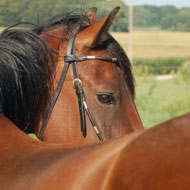
Defra urged to micro-chip all horses
Defra has been reviewing the horse passport system following last year's meat scandal.

Charity's call ahead of review findings


World Horse Welfare is calling on Defra to introduce micro-chipping for all horses when it announces the findings of its review of the passport system next month.

The review follows last year's food scandal in which horsemeat was found in beef products.

The charity says that the law at the moment only requires horses born after 2009 to be micro-chipped, leaving hundreds of older horses untraceable.

A report by World Horse Welfare and other charities also found that in England and Wales, increased breeding coupled with a decrease in the value of horses, meant that some 6,500 horses are at risk of abandonment or neglect, while some are being sold for as little as £5.

World Horse Welfare has been working with Defra to develop changes to the law to ensure against a repeat of the scandal  but says Defra and the European Commission, may be "reluctant" against a move to microchip all horses.

"Tightening to the laws on equine identification – or 'horse passports' – and planning to reintroduce a central database are vital steps forward, but there is a risk that the new laws will not go far enough to ensure a workable, enforceable system," said Roly Owers, chief executive of World Horse Welfare.

"We are urging the European Commission and Defra to take the opportunity afforded by the horse meat scandal to do it right this time around."

The charity said it had been highlighting problems with the horse passport system for a number of years before last year's meat scandal broke.

It has also called for CCTV to be mandatory inside all equine slaughterhouses in Britain following abuse of horses at an English abattoir early last year. A petition of more than 40,000 names has been handed in to Defra calling for mandatory CCTV, although Defra is not said to be in favour of the move.


Become a member or log in to add this story to your CPD history

Equine Disease Surveillance report released for Q4 2025

News Story 1
 The latest Equine Disease Surveillance report has been released, with details on equine disease from Q4 of 2025.

The report, produced by Equine Infectious Disease Surveillance, includes advice on rule changes for equine influenza vaccination.

Statistics and maps detail recent outbreaks of equine herpes virus, equine influenza, equine strangles and equine grass sickness. A series of laboratory reports provides data on virology, bacteriology, parasitology and toxicosis.

This issue also features a case study of orthoflavivus-associated neurological disease in a horse in the UK. 

Click here for more...
News Shorts
NSA webinar explores sheep tailing and castration

The National Sheep Association (NSA) is to host a free webinar on the castration and tail docking of lambs.

The webinar, 'Understanding the tailing and castration consultation: A guide for sheep farmers', will be hosted online on Monday, 2 March 2026 at 7.30pm.

It comes during a government consultation into the methods used for these procedures. Farmers are encouraged to engage before the consultation period closes on Monday, 9 March 2026.

The webinar offers clear and actionable guidance to support farmers to contribute meaningfully to the consultation and prepare for potential changes.

On the panel will be former SVS president Kate Hovers, farmer and vet Ann Van Eetvelt and SRUC professor in Animal Health and Veterinary Sciences Cathy Dwyer. Each panel member will utilise their own specialism and expertise to evaluate risks and outcomes to sheep farming.

Find out more about the webinar on the NSA website.

