


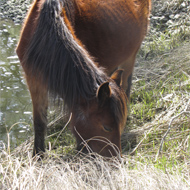
Welfare organisations unite in rally call for Government action
A law that came into effect on Tuesday aimed at tackling fly grazing in Wales, could simply move the problem over the border into England welfare charities have warned.
The Control of Horses (Wales) Act 2014 has been welcomed by organisations such as World Horse Welfare (WHW), the RSPCA, Blue Cross, Redwings and The British Horse Society – but they say that it increases pressure for a similar law to be passed in England.
The new law was seen as such a priority in Wales by Alun Davis AM, The Minister for Natural Resources and Food, that it was fast-tracked through the National Assembly following urgent calls from local authorities, animal welfare charities and the police.
It provides local authorities with the tools to tackle fly grazing, abandonment and the straying of horses.
Figures by WHW say there are at least 7,000 horses at risk of neglect or abandonment across the UK. The WHW says that fly grazing – where horses are left on land without the permission of the landowner – account for half of that number.
The Welsh law gives local authorities the power to immediately seize and impound horses left to fly graze.
They are then returned to the owner if costs have been paid and the animal has been properly identified, or are sold or rehomed. As a last resort the animal would be put to sleep.
Roly Owers, World Horse Welfare chief executive, a veterinarian and member of the Equine Sector Council said: "This is great news for horses that are left to fend for themselves in Wales, allowing them to be dealt with in a quicker and more compassionate way while at the same time discouraging owners from wilfully causing so much suffering to their animals and damage to land they do not own or have permission to graze.
"This move further increases the pressure for action to be taken in England now that fly grazing is more difficult to get away with in Wales, to prevent the problem, as we are already beginning to see, simply moving over the border."
His thoughts were echoed by the RSPCA head of public affairs, David Bowles, who said: “We now need Westminster to introduce similar legislation and provide resources for local authorities to carry it out in England.
"Otherwise we are deeply concerned that the problem will simply transfer across the border and put even more pressure on equine charities, landowners and local authorities."
Redwings chief executive, Lynn Cutress said the Government needed to bring in similar laws in England, while Rachel Cunningham, public affairs manager at Blue Cross said: “Charities, land owners and local authorities cannot continue to manage this crisis alone.”
The British Horse Society's director of policy, Lee Hackett, said: "We are delighted that the Bill has received Royal Assent and huge credit has to go to everyone involved for making this happen so quickly.
"The Welsh Government is to be commended for listening to the welfare sector and taking proactive action to help in our battle against the enormous levels of equine suffering we are seeing on a daily basis.
"We just have to hope that the politicians of Westminster are watching and will be encouraged to step up to the plate and take the action that we so desperately need.”
The group of organisations are running a campaign to put pressure on Defra to introduce new laws on fly grazing.


 BVA has announced a new series of its Building Great Workplaces lunchtime webinars.



