
Your data on MRCVSonline
The nature of the services provided by Vision Media means that we might obtain certain information about you.
Please read our Data Protection and Privacy Policy for details.

In addition, (with your consent) some parts of our website may store a 'cookie' in your browser for the purposes of
functionality or performance monitoring.
Click here to manage your settings.
If you would like to forward this story on to a friend, simply fill in the form below and click send.

Your friend's email:
Your email:
Your name:
 
 
Send Cancel

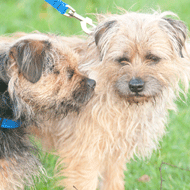
Border terrier plays guide dog for blind son
Lucky and Scruff
Lucky and Scruff

Young dog thrives with the help of faithful father and vets

A devoted canine father has taken on the role of guide dog for his son Lucky, who was born without retinas and has never been able to see.

Lucky's blindness initially caused problems and he would often get lumps and bumps from running head-first into things.

With a little help from faithful father Scruff, the vets at PDSA and his loving owners, two-year-old Lucky is now coping extremely well with his disability.

Senior PDSA vet, Elaine Pendlebury, said: "Dogs can behave in a unique and extraordinary way. They’re extremely social animals and can help both pets and people in ways that never fail to amaze.

"It’s inspiring to us all that Scruff acts as a guide dog to his canine companion and how he looks after his son to the best of his ability."

Owner Jim Leonard, 65, from Glasgow, says the family were initially worried about how Lucky would cope with his blindness.

"We started to take Lucky and Scruff on walks together and it was amazing to see Scruff starting to take charge, looking after Lucky and checking he was okay.

"Now Scruff licks him on the face and guides him where to go. If they are separated for a little while, Scruff will rush over to Lucky and lick him as if to say ‘sorry I had to leave you’."

After discussing the problem with PDSA vets, Jim says the family took several steps to make life easier for Lucky, including wearing bells at the bottom of their trousers and putting strong scents in rooms where there are objects he may hurt himself on, training Lucky not to go in there.

Jim said: "It’s hard work to care for a pet with a disability but so rewarding. We’re extremely grateful to the PDSA vets and nurses at the pet hospital in Tollcross for the help and support they have given us and Lucky, which has helped him to blossom into a loving, confident dog."

Image courtesy of PDSA

Become a member or log in to add this story to your CPD history

Equine Disease Surveillance report released for Q4 2025

News Story 1
 The latest Equine Disease Surveillance report has been released, with details on equine disease from Q4 of 2025.

The report, produced by Equine Infectious Disease Surveillance, includes advice on rule changes for equine influenza vaccination.

Statistics and maps detail recent outbreaks of equine herpes virus, equine influenza, equine strangles and equine grass sickness. A series of laboratory reports provides data on virology, bacteriology, parasitology and toxicosis.

This issue also features a case study of orthoflavivus-associated neurological disease in a horse in the UK. 

Click here for more...
News Shorts
NSA webinar explores sheep tailing and castration

The National Sheep Association (NSA) is to host a free webinar on the castration and tail docking of lambs.

The webinar, 'Understanding the tailing and castration consultation: A guide for sheep farmers', will be hosted online on Monday, 2 March 2026 at 7.30pm.

It comes during a government consultation into the methods used for these procedures. Farmers are encouraged to engage before the consultation period closes on Monday, 9 March 2026.

The webinar offers clear and actionable guidance to support farmers to contribute meaningfully to the consultation and prepare for potential changes.

On the panel will be former SVS president Kate Hovers, farmer and vet Ann Van Eetvelt and SRUC professor in Animal Health and Veterinary Sciences Cathy Dwyer. Each panel member will utilise their own specialism and expertise to evaluate risks and outcomes to sheep farming.

Find out more about the webinar on the NSA website.


