
Your data on MRCVSonline
The nature of the services provided by Vision Media means that we might obtain certain information about you.
Please read our Data Protection and Privacy Policy for details.

In addition, (with your consent) some parts of our website may store a 'cookie' in your browser for the purposes of
functionality or performance monitoring.
Click here to manage your settings.
If you would like to forward this story on to a friend, simply fill in the form below and click send.

Your friend's email:
Your email:
Your name:
 
 
Send Cancel

Scientists launch £1m project to tackle liver fluke
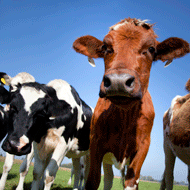
Image cattle
Liver fluke in cattle costs the UK economy £300m a year.

Improving the detection and control of disease in cattle

Liverpool scientists are heading up a £1 million project to tackle liver fluke - a disease that costs the UK economy £300 million each year.

Researchers from the University of Liverpool will look at methods to improve the detection and control of liver fluke in cattle.

The disease is found on 75 per cent of UK dairy farms and causes weight loss, lethargy and anaemia in cattle.

Professor Diana Williams, a veterinary pathologist from the university's Institute of Infection and Global Health says the disease is on the rise due to climate change and changes in farming practices.

"It is fast becoming difficult to treat because of growing resistance to medication," she explains.
Scientists are joining forces with the farming industry to undertake the four-year research project.

Prof Williams said: "We will look at husbandry practices and physical and environmental factors from a study of 250 farms to feed into statistical and mathematical models that will help us determine more effectively why some farms have fluke whilst others in close proximity do not."

Scientists will also aim to improve drug treatments at particular times in the year to help slow the development of drug resistance.

In addition, as the disease is transmitted by the dwarf pond snail, the team will create a system to categorise snail habitats. These will then be used alongside satellite imagery for individual farms.


Become a member or log in to add this story to your CPD history

Submissions open for BSAVA Clinical Research Abstracts 2026

News Story 1
 The BSAVA has opened submissions for the BSAVA Clinical Research Abstracts 2026.

It is an opportunity for applicants to present new research on any veterinary subject, such as the preliminary results of a study, discussion of a new technique or a description of an interesting case.

They must be based on high-quality clinical research conducted in industry, practice or academia, and summarised in 250 words.

Applications are welcome from vets, vet nurses, practice managers, and students.

Submissions are open until 6 March 2026. 

Click here for more...
News Shorts
Survey seeks ruminant sector views on antimicrobial stewardship

A new survey is seeking views of people working in the UK ruminant sector on how to tackle the challenge of demonstrating responsible antibiotic stewardship.

Forming part of a wider, collaborative initiative, the results will help identify the types of data available so that challenges with data collection can be better understood and addressed.

Anyone working in the UK farming sector, including vets and farmers,is encouraged to complete the survey, which is available at app.onlinesurveys.jisc.ac.uk

