


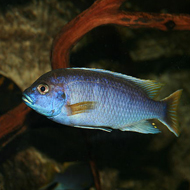
Scientists make find after study of cichlid fish in East Africa
A study of cichlid fishes (Telmatochromis temporalis) in Lake Tanganyika in East Africa, found two genetically distinct ecomorphs (local varieties of a species whose appearance is determined by its ecological environment), that strongly differ in body size and the habitat in which they live.
Dr Martin Genner from Bristol's School of Biological Sciences said: "We found large-sized individuals living along the rocky shoreline of Lake Tanganyika and, in the vicinity of these shores, we found small-sized individuals, roughly half the size of the large ones, that live and breed in accumulations of empty snail shells found on sand."
According to the study published in Nature Communications, bigger fish outcompete the smaller ones, driving them away from the preferred rocky habitats and into the neighbouring sand, where the smaller fish find shelter for themselves and their eggs in empty snail shells.
“In effect, big and small fish use different habitats; and because of this habitat segregation, fish usually mate with individuals of similar size. There is virtually no genetic exchange between the large- and small-bodied ectomorphs,” Dr Genner said.
"The relevance of our work is that it provides experimental evidence that competition for space drives differential mating in cichlid fish and, in time, leads to the formation of new species.
"Nature has its ways – from body size differences to the formation of new species. And clearly, size does matters for Telmatochromis and for fish diversity."
The study was carried out by evolutionary biologists from the University of Bristol, the Natural History Museum London, the University of Kyoto and the Natural History Museum in Bern.
Image by Toby Hudson


 BVA has announced a new series of its Building Great Workplaces lunchtime webinars.



