Your data on MRCVSonline
The nature of the services provided by Vision Media means that we might obtain certain information about you.
Please read our Data Protection and Privacy Policy for details.

In addition, (with your consent) some parts of our website may store a 'cookie' in your browser for the purposes of
functionality or performance monitoring.
Click here to manage your settings.
If you would like to forward this story on to a friend, simply fill in the form below and click send.

Your friend's email:
Your email:
Your name:
 
 
Send Cancel

Why do penguins need jumpers?
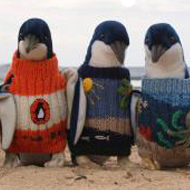
The Phillip Island Penguin Foundation recently ran a best jumper competition as part of its Knit for Nature initiative.

How best knits help oil spill birds

Jumpers have been knitted for little penguins affected by oil spills in Australian to stop them preening and swallowing toxins.

The Phillip Island Penguin Foundation which launched a Knit for Nature programme, said:  "A patch of oil the size of a thumb nail can kill a little penguin.

"Oiled penguins often die from exposure and starvation.

"Oil separates and mats feathers, allowing water to get in which makes a penguin very cold, heavy and less able to successfully hunt for food."

The jumpers are placed on the penguins to stop them preening while they wait to be washed by clinic staff.

Phillip Island is home to an estimated 32,000 little penguins.

The last major oil spill off the island happened in 2001 and affected 453 little penguins – 96 per cent of them were saved and rehabilitated at the Phillip Island Wildlife Clinic before being released back into the wild.


The foundation recently ran a knitting competition and said it has been overwhelmed with offers of jumpers from around the world, so much so that it is able to send the jumpers on to other rescue centres if required.

In 201/13 582 sick animals were admitted to the Phillip Island Wildlife Clinic of which 141 were little penguins.

The foundation raises funds for the rescue and care of sick or injured little penguins.  It also runs an adopt a penguin programme.

Become a member or log in to add this story to your CPD history

Equine Disease Surveillance report released for Q4 2025

News Story 1
 The latest Equine Disease Surveillance report has been released, with details on equine disease from Q4 of 2025.

The report, produced by Equine Infectious Disease Surveillance, includes advice on rule changes for equine influenza vaccination.

Statistics and maps detail recent outbreaks of equine herpes virus, equine influenza, equine strangles and equine grass sickness. A series of laboratory reports provides data on virology, bacteriology, parasitology and toxicosis.

This issue also features a case study of orthoflavivus-associated neurological disease in a horse in the UK. 

Click here for more...
News Shorts
NSA webinar explores sheep tailing and castration

The National Sheep Association (NSA) is to host a free webinar on the castration and tail docking of lambs.

The webinar, 'Understanding the tailing and castration consultation: A guide for sheep farmers', will be hosted online on Monday, 2 March 2026 at 7.30pm.

It comes during a government consultation into the methods used for these procedures. Farmers are encouraged to engage before the consultation period closes on Monday, 9 March 2026.

The webinar offers clear and actionable guidance to support farmers to contribute meaningfully to the consultation and prepare for potential changes.

On the panel will be former SVS president Kate Hovers, farmer and vet Ann Van Eetvelt and SRUC professor in Animal Health and Veterinary Sciences Cathy Dwyer. Each panel member will utilise their own specialism and expertise to evaluate risks and outcomes to sheep farming.

Find out more about the webinar on the NSA website.