
Your data on MRCVSonline
The nature of the services provided by Vision Media means that we might obtain certain information about you.
Please read our Data Protection and Privacy Policy for details.

In addition, (with your consent) some parts of our website may store a 'cookie' in your browser for the purposes of
functionality or performance monitoring.
Click here to manage your settings.
If you would like to forward this story on to a friend, simply fill in the form below and click send.

Your friend's email:
Your email:
Your name:
 
 
Send Cancel

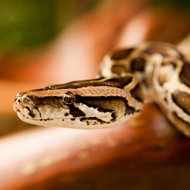
Snakes show "homing" senses
Pythons travelled u to 22 miles over the course of 296 days to return to a "home" location, researchers have found.

Pythons travel up to 22 miles to "home" location during experiment

An experiment has found that Burmese pythons display signs of map and compass senses, allowing them to travel for months to reach a location.

The study by researchers in Florida, for the first time, provides evidence that snakes may share the same compass senses as other species such as sea turtles and pigeons.

The research team took six snakes and relocated them 13 to 22 miles from where they were captured.

"All animals were placed in sealed, opaque plastic containers and were transported by vehicle to release locations (paths taken by researchers were bit direct.

"Snakes were anathematised during implantation surgeries. We radio tracked each python one to three times per week and recorded locations using a GPS from a fixed wing aircraft," said lead author Shannon Pittman in the paper published in The Royal Society journal Biology Letters.

Five of the six snakes reached within three miles of their capture locations while the sixth was moving in the right direction.

"This study provides evidence that Burmese pythons have navigational maps and compass senses .

"In addition, snakes maintained orientated movement over relatively long time scales (94-296 days), demonstrating the maintenance of long-term movement goals and high motivation to reach home locations," the study said.


 

Become a member or log in to add this story to your CPD history

Equine Disease Surveillance report released for Q4 2025

News Story 1
 The latest Equine Disease Surveillance report has been released, with details on equine disease from Q4 of 2025.

The report, produced by Equine Infectious Disease Surveillance, includes advice on rule changes for equine influenza vaccination.

Statistics and maps detail recent outbreaks of equine herpes virus, equine influenza, equine strangles and equine grass sickness. A series of laboratory reports provides data on virology, bacteriology, parasitology and toxicosis.

This issue also features a case study of orthoflavivus-associated neurological disease in a horse in the UK. 

Click here for more...
News Shorts
RCVS annual renewal fee for vets due

RCVS' annual renewal fee for veterinary surgeons is now due. Vets must pay their renewal fee before Wednesday, 1 April 2026.

This year's standard annual fee has increased to 431 from last year's 418. This is an approximately three per cent increase, as approved by RCVS Council and the Privy Council.

Tshidi Gardner, RCVS treasurer, said: "The small fee increase will be used to help deliver both our everyday activities and our new ambitious Strategic Plan, which includes aims such as achieving new legislation, reviewing the Codes of Professional Conduct and supporting guidance, and continuing to support the professions through activities such as the Mind Matters Initiative, RCVS Academy and career development."

A full breakdown of the new fees is on the RCVS website. Information about tax relief is available on the UK government website.

