


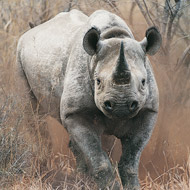
Conservation group warns could wipe out species
The president of the Born Free Foundation is to speak at a South African conference on the rhino horn trade, this week.
The South African government, and the Private Rhino Owners Association are among those that have spoken in favour of the legalisation of the rhino horn trade as a means of stopping poaching and sales on the black market.
The pro lobby argue that selling stockpiles of seized rhino horns could also flood the market, dropping its value and making it less attractive to poachers.
But Will Travers OBE, who is to address the conference in Pretoria, tomorrow and on Wednesday, will speak against such a move.
“I cannot state strongly enough that, in my opinion, promoting the establishment of a legal rhino horn trade will spell disaster for rhino in the wild in South Africa and possibly extinction for rhino in all other range States, such as Kenya, Tanzania and Zimbabwe,” he said.
“If we care about the future of wild rhinos, the only sane decision is to end the speculation about a future trade in rhino horn unequivocally, universally and in perpetuity." It has been reported that 240 rhinos have been killed in South Africa already this year.
The organiser of the conference, OSCAP’S Director Allison Thomson said, “We have never disguised the fact that the principal objective of this conference is to allow the South African public to hear, in detail, the reasons why so many conservationists oppose the legalisation of rhino horn trade. Typically, their voices get drowned out in this country.
“But there is no question that it is also a great opportunity for those who favour a legal trade to make their case. We certainly don’t want to avoid debate, which is what has happened in the past, and that’s why the pro-trade lobby have been invited to attend."
Other speakers will include Peter Knights of WildAid, Mary Rice from the Environmental Investigation Agency, independent consultant Francisco Aguayo, environment lawyer Cormac Cullinan, and leading South African conservationist Ian Michler.
"This is an important opportunity for us to come together to save the rhino and we are running out of time.
"The commercial interests of individuals and the long-held belief that you can sustain wildlife by shooting it, has got to be analysed in light of the strong evidence available," said Mr Travers.
“Rhino conservation is controversial and it is challenging. Fighting poachers is deeply distressing. The suffering of individual rhino is immense.
"I know, we all know, that there are no easy answers and with over 1,000 rhino poached last year in South Africa, and 240 poached so far this year, things are going to continue to be bloody without prompt action.
"I also know that legalising trade will hasten the demise of a species we all care deeply about.”


 BVA has announced a new series of its Building Great Workplaces lunchtime webinars.



