
Your data on MRCVSonline
The nature of the services provided by Vision Media means that we might obtain certain information about you.
Please read our Data Protection and Privacy Policy for details.

In addition, (with your consent) some parts of our website may store a 'cookie' in your browser for the purposes of
functionality or performance monitoring.
Click here to manage your settings.
If you would like to forward this story on to a friend, simply fill in the form below and click send.

Your friend's email:
Your email:
Your name:
 
 
Send Cancel

Blue Cross rehoming centres reach bursting point
Cobs
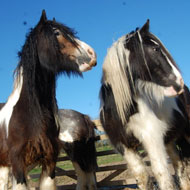
Marula and Olive, two of the rescued cobs

Charity sees 30 per cent rise in the number of horses and ponies coming through its doors

Blue Cross has reported a 30 per cent in the number of horses and ponies coming through its doors this year, stretching its centres to bursting point.

An admission of 60 horses and ponies in the first three months of 2014 has put pressure on resources and resulted in some centres becoming over-full.

Fifty-one of these are cobs who were found abandoned and neglected, but with the potential to become versatile riding horses.

Many are ready to be backed, and the charity is seeking assistance from owners with the knowledge and facilities to provide homes for some of these smart youngsters.

The cobs, many of which are bay, skewbald and piebaled, range from 13hh upwards, and are aged from two years old. They are ready for new homes where they can continue their training and fulfil their potential. Finding homes for these horses will free up space at Blue Cross centres for more urgent welfare cases requiring immediate help.

Vicki Alford, horse manager at Blue Cross Burford said: “We are seriously struggling with space and resources at the moment. This means we can’t easily give the horses that are ready to progress the time and training they need. Most of these cobs have good conformation, movement and temperaments.

"We have laid the foundations for their initial handling and training and are now offering knowledgeable riders a great opportunity to take on a calibre youngster that they can have the satisfaction of backing and bringing on themselves.”

Horse welfare is an escalating crisis in the UK, with an estimated 7,000 horses and ponies currently at risk. This puts pressure on horse charities across the country in terms of funding and resources.

If you think you have the time and the facilities to provide one of these horses with a good home, or to make a donation to the Blue Cross, visit their website.

Image courtesy of Blue Cross


Become a member or log in to add this story to your CPD history

Equine Disease Surveillance report released for Q4 2025

News Story 1
 The latest Equine Disease Surveillance report has been released, with details on equine disease from Q4 of 2025.

The report, produced by Equine Infectious Disease Surveillance, includes advice on rule changes for equine influenza vaccination.

Statistics and maps detail recent outbreaks of equine herpes virus, equine influenza, equine strangles and equine grass sickness. A series of laboratory reports provides data on virology, bacteriology, parasitology and toxicosis.

This issue also features a case study of orthoflavivus-associated neurological disease in a horse in the UK. 

Click here for more...
News Shorts
NSA webinar explores sheep tailing and castration

The National Sheep Association (NSA) is to host a free webinar on the castration and tail docking of lambs.

The webinar, 'Understanding the tailing and castration consultation: A guide for sheep farmers', will be hosted online on Monday, 2 March 2026 at 7.30pm.

It comes during a government consultation into the methods used for these procedures. Farmers are encouraged to engage before the consultation period closes on Monday, 9 March 2026.

The webinar offers clear and actionable guidance to support farmers to contribute meaningfully to the consultation and prepare for potential changes.

On the panel will be former SVS president Kate Hovers, farmer and vet Ann Van Eetvelt and SRUC professor in Animal Health and Veterinary Sciences Cathy Dwyer. Each panel member will utilise their own specialism and expertise to evaluate risks and outcomes to sheep farming.

Find out more about the webinar on the NSA website.

