
Your data on MRCVSonline
The nature of the services provided by Vision Media means that we might obtain certain information about you.
Please read our Data Protection and Privacy Policy for details.

In addition, (with your consent) some parts of our website may store a 'cookie' in your browser for the purposes of
functionality or performance monitoring.
Click here to manage your settings.
If you would like to forward this story on to a friend, simply fill in the form below and click send.

Your friend's email:
Your email:
Your name:
 
 
Send Cancel

ZSL welcomes rare baby crocodiles
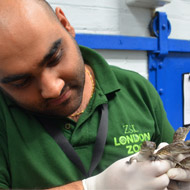
Iri Gill checks the Philippine Crocodile hatchlings

Zookeepers capture the incredible process on camera

ZSL London Zoo has welcomed the first ever Philippine crocodiles to be bred in a UK Zoo.

Weighing in at just 37 grams, the first of the young crocodiles emerged from its egg on June 16, followed by its five siblings over a 48-hour period.

One of the world's rarest reptiles and native only to the Philippines, the baby crocodiles have been named after the islands that they inhabit; Jolo, Mindoro, Samar, Sulo, and Mindanao.
 
Classified as Critically Endangered due to habitat loss and being hunted for their skins, the six hatchlings are a huge cause for celebration at ZSL London Zoo and the UK, helping to boost the numbers of this rapidly-declining species. Deputy head of the reptile house, Iri Gill, said: "We couldn't be more thrilled".

The parent crocodiles play a hugely significant role in the European Breeding programme for the species. The parents were born at a conservation centre in the Phillipines and were matched as the founding animals for the programme which ensures that the most genetically-diverse animals are placed together.
 
Iri Gill said: “Currently measuring just 24cms in length and looking like perfect miniature models of their parents, the yet to be sexed hatchlings will eventually grow up to three metres in length.
 
“Not only are these crocodiles the first of their kind to ever be bred in a UK zoo, but they are also a fantastic addition to the European breeding programme – and we can now use our experience to help other zoos breed these Critically Endangered animals.”

Image courtesy of ZSL London Zoo

 

Become a member or log in to add this story to your CPD history

Equine Disease Surveillance report released for Q4 2025

News Story 1
 The latest Equine Disease Surveillance report has been released, with details on equine disease from Q4 of 2025.

The report, produced by Equine Infectious Disease Surveillance, includes advice on rule changes for equine influenza vaccination.

Statistics and maps detail recent outbreaks of equine herpes virus, equine influenza, equine strangles and equine grass sickness. A series of laboratory reports provides data on virology, bacteriology, parasitology and toxicosis.

This issue also features a case study of orthoflavivus-associated neurological disease in a horse in the UK. 

Click here for more...
News Shorts
RCVS annual renewal fee for vets due

RCVS' annual renewal fee for veterinary surgeons is now due. Vets must pay their renewal fee before Wednesday, 1 April 2026.

This year's standard annual fee has increased to 431 from last year's 418. This is an approximately three per cent increase, as approved by RCVS Council and the Privy Council.

Tshidi Gardner, RCVS treasurer, said: "The small fee increase will be used to help deliver both our everyday activities and our new ambitious Strategic Plan, which includes aims such as achieving new legislation, reviewing the Codes of Professional Conduct and supporting guidance, and continuing to support the professions through activities such as the Mind Matters Initiative, RCVS Academy and career development."

A full breakdown of the new fees is on the RCVS website. Information about tax relief is available on the UK government website.


