
Your data on MRCVSonline
The nature of the services provided by Vision Media means that we might obtain certain information about you.
Please read our Data Protection and Privacy Policy for details.

In addition, (with your consent) some parts of our website may store a 'cookie' in your browser for the purposes of
functionality or performance monitoring.
Click here to manage your settings.
If you would like to forward this story on to a friend, simply fill in the form below and click send.

Your friend's email:
Your email:
Your name:
 
 
Send Cancel

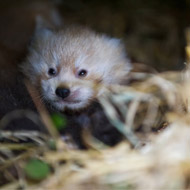
Red panda gives birth to twins
Red panda cub - credit Alex Riddell
It will be a few weeks before the cubs will be on display.

The twins are the second successful red panda birth at Highland Wildlife Park

The Highland Wildlife Park at Kincraig, near Aviemore, is celebrating the birth of twin red panda cubs. The twins were born on the June 15, but images of the tiny cubs have only just been released.

This is the second successful red panda birth at the park as mum, Kitty, also reared a single male cub called Kush in 2013. Kush was the first red panda to be born in one of the Royal Zoological Society of Scotland's animal collections in 13 years.

Douglas Richardson, head of living collections for the Highland Wildlife Park, comments: “We are of course thrilled by the birth of twin red pandas, but it is doubly satisfying as a number of red panda pairs in zoos breed once, then do nothing in subsequent years. 

"The fact that Kitty has produced cubs two years in a row is a very strong indication that our enclosure, diet and husbandry regime suits this pair of pandas.”

Native to the Himalayas, red pandas are classified as vulnerable on the IUCN Red List with less than 10,000 individuals thought to remain in the wild - the major threat being the destruction by man of the forested mountain areas where they live. Although they are protected in all the countries where they are found, they are still hunted illegally for their fur and in particular their long bushy tail which is highly prized as a good luck charm for Chinese newlyweds.

It will be a few weeks before Kitty, her mate Kevyn and the un-named cubs, whose sexes are still unknown, will be on display. The park say that "this is a delicate time for both mum and infants."  Red Panda cubs are born blind, only opening their eyes after about 18 days.

Image courtesy of Highland Wildlife Park. Credit: Alex Riddell

Become a member or log in to add this story to your CPD history

Equine Disease Surveillance report released for Q4 2025

News Story 1
 The latest Equine Disease Surveillance report has been released, with details on equine disease from Q4 of 2025.

The report, produced by Equine Infectious Disease Surveillance, includes advice on rule changes for equine influenza vaccination.

Statistics and maps detail recent outbreaks of equine herpes virus, equine influenza, equine strangles and equine grass sickness. A series of laboratory reports provides data on virology, bacteriology, parasitology and toxicosis.

This issue also features a case study of orthoflavivus-associated neurological disease in a horse in the UK. 

Click here for more...
News Shorts
RCVS annual renewal fee for vets due

RCVS' annual renewal fee for veterinary surgeons is now due. Vets must pay their renewal fee before Wednesday, 1 April 2026.

This year's standard annual fee has increased to 431 from last year's 418. This is an approximately three per cent increase, as approved by RCVS Council and the Privy Council.

Tshidi Gardner, RCVS treasurer, said: "The small fee increase will be used to help deliver both our everyday activities and our new ambitious Strategic Plan, which includes aims such as achieving new legislation, reviewing the Codes of Professional Conduct and supporting guidance, and continuing to support the professions through activities such as the Mind Matters Initiative, RCVS Academy and career development."

A full breakdown of the new fees is on the RCVS website. Information about tax relief is available on the UK government website.


