
Your data on MRCVSonline
The nature of the services provided by Vision Media means that we might obtain certain information about you.
Please read our Data Protection and Privacy Policy for details.

In addition, (with your consent) some parts of our website may store a 'cookie' in your browser for the purposes of
functionality or performance monitoring.
Click here to manage your settings.
If you would like to forward this story on to a friend, simply fill in the form below and click send.

Your friend's email:
Your email:
Your name:
 
 
Send Cancel

Ear position is crucial to how horses communicate, study finds
Horse

Study demonstrates how ears and eyes are important in horse communication

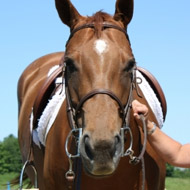
A study by the University of Sussex has discovered that horses use visual cues to work out what might be going on inside a stablemate's head. The study revealed that the direction of the horse's ears are one of the most important factors.

Mammal communication experts set up an experiment to discover which cues horses rely on to judge the direction of another horse's attention in a task where they had to choose where to feed.

Each horse was led to a point where it was released and allowed to choose between two buckets. On a wall behind the buckets, was a life-sized photograph of a horse's head facing either left or right.

The researchers discovered that if the ears or the eyes of the horse in the photograph were obscured, then the horse randomly chose from which bucket to eat. However, if the ears and eyes were visible, then the horse used the directional cues to guide their choice.

Previous work investigating communication of attention has focused on cues that humans use - body orientation, head orientation and eye gaze.

Lead researcher Jennifer Wathan says:  "We found that in horses, their ear position was
also a crucial visual signal. In fact, horses needed to see the detailed facial features of both eyes and ears before they would use another horse’s head direction to guide their choice"

Her colleague, Professor Karen McComb, added: "This study emphasises that animals other than primates are aware of subtle differences in facial expression and can use these to guide the decisions that they make. Fine scaled facial movements can indicate important changes in attention and emotional state and are likely to be crucial in determining social behaviour in a wide range of animals."

The paper, The eyes and ears are visual indicators of attention in domestic horses is published in Current Biology

Become a member or log in to add this story to your CPD history

Equine Disease Surveillance report released for Q4 2025

News Story 1
 The latest Equine Disease Surveillance report has been released, with details on equine disease from Q4 of 2025.

The report, produced by Equine Infectious Disease Surveillance, includes advice on rule changes for equine influenza vaccination.

Statistics and maps detail recent outbreaks of equine herpes virus, equine influenza, equine strangles and equine grass sickness. A series of laboratory reports provides data on virology, bacteriology, parasitology and toxicosis.

This issue also features a case study of orthoflavivus-associated neurological disease in a horse in the UK. 

Click here for more...
News Shorts
NSA webinar explores sheep tailing and castration

The National Sheep Association (NSA) is to host a free webinar on the castration and tail docking of lambs.

The webinar, 'Understanding the tailing and castration consultation: A guide for sheep farmers', will be hosted online on Monday, 2 March 2026 at 7.30pm.

It comes during a government consultation into the methods used for these procedures. Farmers are encouraged to engage before the consultation period closes on Monday, 9 March 2026.

The webinar offers clear and actionable guidance to support farmers to contribute meaningfully to the consultation and prepare for potential changes.

On the panel will be former SVS president Kate Hovers, farmer and vet Ann Van Eetvelt and SRUC professor in Animal Health and Veterinary Sciences Cathy Dwyer. Each panel member will utilise their own specialism and expertise to evaluate risks and outcomes to sheep farming.

Find out more about the webinar on the NSA website.



