Your data on MRCVSonline
The nature of the services provided by Vision Media means that we might obtain certain information about you.
Please read our Data Protection and Privacy Policy for details.

In addition, (with your consent) some parts of our website may store a 'cookie' in your browser for the purposes of
functionality or performance monitoring.
Click here to manage your settings.
If you would like to forward this story on to a friend, simply fill in the form below and click send.

Your friend's email:
Your email:
Your name:
 
 
Send Cancel

Rare zebra shark born at Sea Life Centre
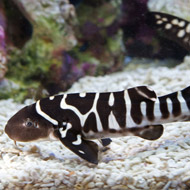
Zebra fish
Zebra sharks are sold for human consumption and oriental medicine

Zebra sharks are currently classified as Vulnerable on the IUCN Red List

Aquarists at The National Sea Life Centre Birmingham are celebrating the arrival of a rare baby zebra shark.

The pup, which has yet to be named,  hatched on Tuesday, August 19, following a six-month incubation period, after an egg was donated from an aquarium in America.

At only 25cm long, the baby is already displaying the distinctive stripes that give this shark its name. The Centre say that is could grow to a whopping 2.5 meters in length when it reaches adulthood.

Zebra sharks are currently classified as Vulnerable on the International Union for Conservation of Nature's (IUCN) Red List of biological species. This is largely because they are sold for human consumption and for fish meat. There is also a huge market for shark-fin soup and oriental medicine.

James Robson, Curator at the National SEA LIFE Centre Birmingham, comments: “It’s always exciting when we have a new birth at the attraction, but especially in cases such as this when the species is struggling in the wild.

“We’re very happy to report that our pup is thriving. It’s currently in a nursery tank so we can keep a close eye on it but will eventually be moved to our Breed, Rescue, Protect zone where we have brown banded and horned sharks on display, alongside other developing eggs of sharks.

“The aim is to add our pup to the larger breeding population of the Zebra shark species once it comes of age in order to help protect and conserve these magnificent creatures.”

Image courtesy of the National Sea Life Centre

Become a member or log in to add this story to your CPD history

Equine Disease Surveillance report released for Q4 2025

News Story 1
 The latest Equine Disease Surveillance report has been released, with details on equine disease from Q4 of 2025.

The report, produced by Equine Infectious Disease Surveillance, includes advice on rule changes for equine influenza vaccination.

Statistics and maps detail recent outbreaks of equine herpes virus, equine influenza, equine strangles and equine grass sickness. A series of laboratory reports provides data on virology, bacteriology, parasitology and toxicosis.

This issue also features a case study of orthoflavivus-associated neurological disease in a horse in the UK. 

Click here for more...
News Shorts
RCVS annual renewal fee for vets due

RCVS' annual renewal fee for veterinary surgeons is now due. Vets must pay their renewal fee before Wednesday, 1 April 2026.

This year's standard annual fee has increased to 431 from last year's 418. This is an approximately three per cent increase, as approved by RCVS Council and the Privy Council.

Tshidi Gardner, RCVS treasurer, said: "The small fee increase will be used to help deliver both our everyday activities and our new ambitious Strategic Plan, which includes aims such as achieving new legislation, reviewing the Codes of Professional Conduct and supporting guidance, and continuing to support the professions through activities such as the Mind Matters Initiative, RCVS Academy and career development."

A full breakdown of the new fees is on the RCVS website. Information about tax relief is available on the UK government website.