


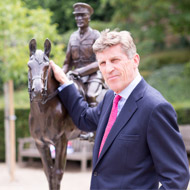
Honorary Dickin Medal awarded to Warrior on behalf of all animals that served in WW1
A prestigious Honorary PDSA Dickin Medal - the animal equivalent of the Victoria Cross - will be presented today to heroic war horse, Warrior.
The award, which also honours the gallantry and devotion of millions of animals that served with armed forces during the First World War, is the first to ever be presented in the veterinary charity's 97 year history.
Warrior, who was dubbed 'the horse the Germans could not kill', posthumously receives his honorary medal at a special ceremony at the IWM London this evening. The award will be accepted by broadcaster and author Brough Scott MBE, who is the grandson of Warrior's owner and rider, General Jack Seely.
Warrior arrived on the Western Front on August 11, 1914 with General Jack Seely and remained on the front line throughout the war. He was subjected to machine gun attacks and survived falling shells at the Battle of the Somme. He was dug out of the mud at Passchendaele and twice trapped under the burning beams of his stables.
According to records, Warrior displayed gallantry above and beyond the call of duty. He inspired the soldiers as they faced their greatest fears in battles against gas, tanks, bullets and bayonets.
Despite suffering several injuries, Warrior survived the war and returned home to the Isle of Wight in 1918, where he lived with the Seely family until his death, aged 33.
Stephen Spielberg, director of the Oscar-nominated film War Horse, has shown his support for the honorary award.
Spielberg said: "Warrior is an extraordinary example of the resilience, strength, and profound contribution that horses made to the Great War. Recognising him with an Honorary PDSA Dickin Medal is a fitting and poignant tribute not only to this remarkable animal, but to all animals that served.”
The Dickin Medal is recognised as the highest award any animal can receive whilst serving in military conflict. It was instituted by the PDSA's founder, Maria Dickin, CBE, in 1943, who was inspired to do so by the gallantry displayed by animals on active service in World War Two.
Since the introduction of the medal, it has been awarded to 65 animals including dogs, pigeons, horses and a cat. Warrior is the first to receive an honorary award and the first ever World War One recipient.
PDSA director general Jan McLoughlin, said: “Warrior’s gallantry and devotion to duty throughout World War I reflects the bravery shown by the millions of horses, dogs, pigeons and other animals engaged in the war. That is why he is a worthy recipient of this very special Honorary PDSA Dickin Medal – the first and only of its kind."
Commenting on the award, Brough Scott, MBE, said: “My family and I are more than honoured that Warrior has been given this award on behalf of all animals that also served; we are truly humbled. I only wish Jack Seely were here today to witness Warrior receiving the animal equivalent of the Victoria Cross.”


 BVA has announced a new series of its Building Great Workplaces lunchtime webinars.



