


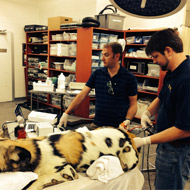
UC Davis vet travels America to help zoos tackle fertility problems
A veterinary surgeon from the University of California, Davis' School of Veterinary Medicine, is taking measures to do what he can to combat the increasing numbers of animals becoming endangered throughout the world.
Dr Bruce Christensen, a reproduction specialist, has been travelling for the past year throughout the United States, assisting wildlife habitats and zoos with fertility problems in several endangered species. Together with curatorial and veterinary colleagues at the local facilities, Dr Christensen examined several animals, including African painted dogs, red and Mexican wolves and an African lion.
His first stop was at a wolf sanctuary in Washington. Five litters of Mexican gray wolves have been born at the sanctuary over the years, and 11 adults have been released back into the wild. Not having much success recently, the sanctuary asked for advice from the Wildlife Contraception Centre (WCC), who in turn arranged for Dr. Christensen to evaluate their concerns.
Dr Christensen took a biopsy of the uterine walls of two red wolves and two Mexican gray wolves. The examinations, carried out to determine if reproduction failure could be associated with the females, showed few abnormalities if any at all, so the sanctuary was then able to focus more on the males.
A few months later, the Saint Louis Zoo asked Dr Christensen to train one of their staff veterinary surgeons, Dr Chris Hanley, in performing the uterine biopsy procedure. Together they performed the technique for the first time on an African lion. The lioness had been exhibiting erratic reproductive cycles due to being on chemical contraception for many years. Uterine samples were successfully obtained and later evaluated.
Dr Christensen's last stop was at the world-famous Bronx Zoo in New York, which breeds African painted dogs as part of the Association of Zoos and Aquarium's (AZA) Species Survival Plan.
Two of the breeding females in the zoo's current pack have not successfully produced any litters. The strategy going forward is to try pairing the females with different males. Dr Christensen was brought in to ascertain if the females' uteri had any problems that were contributing to the reproductive failures.
Dr Christensen performed uterine biopsies and cultures on the two females to determine if there were any larger issues at hand than just changing mates. With an estimated population of just 3,000 to 6,000 dogs remaining the the wild, it is vital that the zoo explores all possibilities in order to maintain its African painted dog pack.
To view photos from Dr Christensen's trip, visit https://www.facebook.com/media/set/?set=a.10152738033384031.1073741864.164666034030&type=1
Image (C) University of California, Davis' School of Veterinary Medicine


 BVA has announced a new series of its Building Great Workplaces lunchtime webinars.



