


Changes to the training of official veterinarians
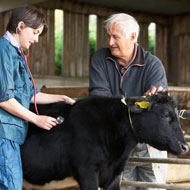
The OCQ(V) will replace the old OV Panels.
As of March 31, 2015 all official veterinarians (OVs) must hold a new qualification to attain or retain their status. Registration opened in August and the first courses have become available this month.
The AHVLA announced plans to change its approach to OV training in July 2013. Following a tendering process it was revealed earlier this year that the contract for OV training had been awarded to Improve International.
The company will develop and deliver the training alongside Harper Adams University and the European School of Veterinary Post-graduate Studies.
A new Official Controls Qualification (Veterinary) qualification has been introduced by the AHVLA to replace the existing OV panels.
OCQ(V) will be followed by two letters signifying the area of work covered, for example ES (essential skills, which is a pre-requisite for all other modules except for CA – companion animal), TT (tuberculin testing) or AX (avian export).
Under “grandfather rights” existing OVs will not have to complete the initial training for the OCQ(V) modules equivalent to their OV panels, assuming they have refreshed their knowledge of OV instructions and the RCVS code.
Some OV panels are not covered however, as they are no longer required, for example 1d other notifiable diseases, 1e market inspections and 1r bluetongue.
Courses can be taken online, costing from £99 to a maximum of £249 plus VAT.
Candidates have been able to register online with Improve since August. There is a one-off registration fee of £59 plus VAT. Discounts are available for early registration, bringing the cost down to £39 plus VAT. Student vets also pay the reduced fee of £49 plus VAT.
To retain their status, even existing OVs must register with Improve by March 31, 2015 to select the panels they wish to keep. These will transfer to OCQ(V)'s without the need for extra training, but will need to be revalidated periodically.
Any OVs who have not registered by the end of March next year will have their status removed and will need to complete the full training to gain the OCQ(V).
Three modules became available this month – tuberculin testing (TT), essential skills (ES) and companion animals (CA). All other courses will be introduced by February next year. TT also requires a practical skills assessment as well as completion of the online course.
Once the course is complete, Improve will notify AHVLA, who will authorise the vet as an OV. The candidate cannot work as an OV prior to receiving this authorisation.
The only exception is for TT, where provisional authorisation is acquired on completion of the course, allowing the candidate to conduct TB skin tests only under the supervision of a fully qualified tester.
Periodic revalidation will now be required to maintain OV status. Revalidation periods vary from two to five years depending on the module. If qualifications are not revalidated, OVs will be required to complete full OCQ(V) training again to regain their status. Revalidation courses will become available from April 2015, although for TT they could be available as soon as December this year.
For further information, see: http://ahvla.defra.gov.uk/documents/ov/ov-training-revalidation-qa.pdf


 Defra has published guidance for the vet sector ahead of a proposed UK-EU Sanitary and Phytosanitary agreement.



