


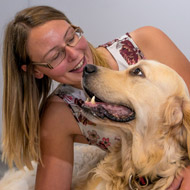
revealed that dogs process human speech in a similar way to us.
Dogs use different parts of the brain to process the verb components of a familiar sentence
A study by the University of Sussex has revealed that dogs process human speech in a similar way to us.
A group of mammal communication researchers from the School of Psychology tested over 250 dogs to learn how they responded to a set of spoken commands. They discovered that, like humans, dogs use different parts of the brain to process the verb components of a familiar sentence and the emotion or intonation of the speaker.
However, the authors of the study stress that their research does not suggest dogs could understand the full complexity of human speech, only that their perception of speech parallels that of humans.
Victoria Ratcliffe said: “Humans mainly use the left hemisphere of their brain to process the verbal content of speech and the right hemisphere to process the characteristics of the voice - whether it’s familiar, male or female - and its emotional content.
“Previous studies have shown that other mammals also have hemispheric biases when processing their own species’ vocalisations, but no one had ever looked at whether biases existed in domesticated animals in response to the different components of human speech.”
The researchers played a human speech sound through speakers on both the left and the right side of individual dogs - the significance being that the left ear sends information to the right side of the brain, and vice-versa.
If the dog turned toward the right speaker, it meant that the information they were listening to was being processed primarily on the left side of the dogs brain. If it turned to the left, the information was being processed on the right of the brain.
The results revealed that when speech is meaningful for dogs (such as the command "come on then"), but the voice features such as gender or innovation had been removed, the dogs were more likely to turn to the right, therefore showing a left-hemispheric bias.
However, if the command was in a foreign in language, or if the phonemes were put into the wrong order ("thon om ken"), the sound ceased to be meaningful to the dogs and the opposite was observed.
Victoria Ratcliffe said: “Although we cannot say to what extent they understand the complexity of the verbal content, our study does suggest that dogs pay attention to this information in human speech and that they perceive its content in a way that broadly parallels human perception.”
"Orienting asymmetries in dogs' responses to different communicatory components of human speech" by Miss Victoria Ratcliffe and Dr David Reby, is published online in Current Biology on 26 November 2014.
Image (C) Stuart Robinson/University of Sussex


 BVA has announced a new series of its Building Great Workplaces lunchtime webinars.



