
Your data on MRCVSonline
The nature of the services provided by Vision Media means that we might obtain certain information about you.
Please read our Data Protection and Privacy Policy for details.

In addition, (with your consent) some parts of our website may store a 'cookie' in your browser for the purposes of
functionality or performance monitoring.
Click here to manage your settings.
If you would like to forward this story on to a friend, simply fill in the form below and click send.

Your friend's email:
Your email:
Your name:
 
 
Send Cancel

Birds evacuate nests ahead of tornado outbreak
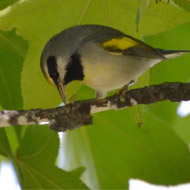
gold-winged warbler
Gold-winged warbler

Birds fled while the storm was still 250-560 miles away

A population of gold-winged warblers "evacuated" their nesting site one day before the April 2014 tornado outbreak in the US, UC Berkeley scientists have revealed.

Whilst tracking a population of golden-winged warblers a research team, led by UC Berkley ecologist Henry Streby, discovered that birds in the mountains of eastern Tennessee fled their breeding ground one to two days ahead of the arrival of powerful storms. The storms swept through the central and southern United States in April, generating 84 tornadoes and killing 35 people.  

“It is the first time we’ve documented this type of storm avoidance behaviour in birds during breeding season." Streby said.

 "We know that birds can alter their route to avoid things during regular migration, but it hadn’t been shown until our study that they would leave once the migration is over and they’d established their breeding territory to escape severe weather,

“The warblers in our study flew at least 1,500 kilometers (932 miles) total to avoid a severe weather system. They then came right back home after the storm passed.”

The researchers say that the birds fled while the storm was still 250-560 miles away, and local environment cues to stormy weather, such as temperature, atmospheric pressure and wind speed, were largely absent.

Streby added: “At the same time that meteorologists on the Weather Channel were telling us this storm was headed in our direction, the birds were apparently already packing their bags and evacuating the area.”

The "evacuation migration" of the gold-winged warblers is published in the journal Current Biology

Image (C) Andy Reago

Become a member or log in to add this story to your CPD history

Equine Disease Surveillance report released for Q4 2025

News Story 1
 The latest Equine Disease Surveillance report has been released, with details on equine disease from Q4 of 2025.

The report, produced by Equine Infectious Disease Surveillance, includes advice on rule changes for equine influenza vaccination.

Statistics and maps detail recent outbreaks of equine herpes virus, equine influenza, equine strangles and equine grass sickness. A series of laboratory reports provides data on virology, bacteriology, parasitology and toxicosis.

This issue also features a case study of orthoflavivus-associated neurological disease in a horse in the UK. 

Click here for more...
News Shorts
NSA webinar explores sheep tailing and castration

The National Sheep Association (NSA) is to host a free webinar on the castration and tail docking of lambs.

The webinar, 'Understanding the tailing and castration consultation: A guide for sheep farmers', will be hosted online on Monday, 2 March 2026 at 7.30pm.

It comes during a government consultation into the methods used for these procedures. Farmers are encouraged to engage before the consultation period closes on Monday, 9 March 2026.

The webinar offers clear and actionable guidance to support farmers to contribute meaningfully to the consultation and prepare for potential changes.

On the panel will be former SVS president Kate Hovers, farmer and vet Ann Van Eetvelt and SRUC professor in Animal Health and Veterinary Sciences Cathy Dwyer. Each panel member will utilise their own specialism and expertise to evaluate risks and outcomes to sheep farming.

Find out more about the webinar on the NSA website.



