


Veterinary dentistry: the need to educate clients
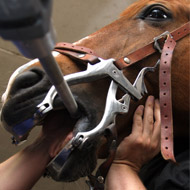
Having 'educational evenings' can be a good way to help improve client understanding of their horse's dental needs.
Veterinary surgeon Chris Pearce, one of the first holders of the new ECVS Diploma in Equine Dentistry, talked this morning at the VPMA/SPVS Congress about the need to educate equine clients about dentistry and the need to use qualified people to carry out procedures on their horse's teeth.
Mr Pearce explained that in the past, and to a large extent still, dentistry was carried out by all manner of people. There has been a history of people setting themselves up as ' equine dentists' and impinging on the work of equine veterinary practices, claiming to be able to carry out procedures that in truth they are not qualified to do.
It was only in 1998 that the British Equine Veterinary Association (BEVA) developed the lay 'dentist' legislative framework with the RCVS, while in 1999 the British Association of Equine Dental Technicians (BAEDT) came into being.
Dentistry today has dramatically improved in terms of equipment training and technique but much damage has been done and is still being done by non-professionals seeking to carry out dental work that is really the province of the equine veterinary practice. Mr Pearce explained how equine practices can win back their dental work.
He started by saying that the practice has to educate their clients so that they understand the difference between a qualified equine vet and a 'paraprofessional', or lay person, advertising their services in equine dentistry. Practices also need to invest in modern equipment and have a serious marketing plan using all the different media available to inform clients of their complete equine service.
He also talked about educating clients more in equine dental problems, highlighting this with the example of how horses are very good at disguising dental pain, so that by the time the client takes action and calls the vet it can often be too late. Having 'educational evenings' can be a good way to help improve client understanding of their horses' dental needs.
Mr Pearce emphasised that there needs to be a practice approach to good dentistry, and, following on from that, good business. His suggestions were to take dentistry seriously, visit horses twice each year, educate all staff and invest in the best equipment to do the work. Also of vital importance is the role of the equine receptionists who needs to be much better trained in technique for talking to clients, offering appointments and encouraging clients to seek dental help for their horses.


 BVA has announced a new series of its Building Great Workplaces lunchtime webinars.



