
Your data on MRCVSonline
The nature of the services provided by Vision Media means that we might obtain certain information about you.
Please read our Data Protection and Privacy Policy for details.

In addition, (with your consent) some parts of our website may store a 'cookie' in your browser for the purposes of
functionality or performance monitoring.
Click here to manage your settings.
If you would like to forward this story on to a friend, simply fill in the form below and click send.

Your friend's email:
Your email:
Your name:
 
 
Send Cancel

Scientists create TB-resistant cows
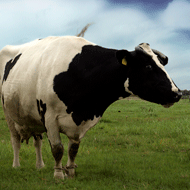
cow
Scientists used a gene editing tool to insert a mouse gene into the genome of cattle.
Mouse gene could hold the key to TB control

Scientists in China have managed to develop 13 genetically-modified cows that are resistant to TB infection.

Using a gene editing tool called TALEN, scientists from the Chinese Ministry of Agriculture were able to insert the mouse gene SP110 - which was already believed to offer protection against TB - into the genome of Holstein-Friesian cattle.

In total, 23 transgenic cattle were produced and 13 of these survived into adulthood. According to the research paper published in Proceedings of the National Academy of Sciences (PNAS), these cattle showed increased resistance to bovine TB.

Mycobacterium bovis was introduced into the lungs of three transgenic cows and three control cows, which were killed 16 weeks after infection. Scientists then examined the lung, lymph nodes, spleen and liver for lesions.

One of the three transgenic cows was found to have no sign of lesions and the two transgenic cows that were infected were found to have a significantly reduced bacterial load in the organs.

A further transmission study found that out of nine transgenic cows, six showed no sign of TB infection and the three with lesions again showed minimal damage to the lung and lymph nodes, compared to the control group.

Commenting on the research, Professor Heiner Niemann, head of the Institute of Farm Animal Genetics in Germany told The Guardian: "These findings are another step towards the creation of disease-resistant livestock animals based on advanced genetic tools."


Become a member or log in to add this story to your CPD history

FIVP launches CMA remedies survey

News Story 1
 FIVP has shared a survey, inviting those working in independent practice to share their views on the CMA's proposed remedies.

The Impact Assessment will help inform the group's response to the CMA, as it prepares to submit further evidence to the Inquiry Group. FIVP will also be attending a hearing in November.

Data will be anonymised and used solely for FIVP's response to the CMA. The survey will close on Friday, 31 October 2025. 

Click here for more...
News Shorts
Free webinar explores congenital heart disease in dogs

A free webinar is to provide veterinary professionals, dog breeders and pet owners an new insights into congenital heart disease.

Chris Linney, a cardiology specialist and Veterinary Cardiovascular Society (VSC) member, will present the webinar from 7.00pm to 8.30pm on Wednesday, 12 November.

Dr Linney will explore the types, causes and clinical presentation of congenital heart conditions. This will include diagnostic approaches, treatment pathways and emerging research opportunities.

The session is the third to be organised by The Kennel Club, with the VCS, following an introductory webinar and a talk on acquired heart disease. Dr Linney's webinar consists of a one-hour presentation, followed by a 30-minute question and answer session.

Dr Linney said: "This webinar will be an opportunity to deepen understanding - not just of the diseases themselves, but of how breeders, vets and owners can work together to support affected dogs and improve outcomes for future generations."

Click here to register for the webinar.

