


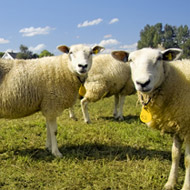
Moredun scientists awarded three new grants
Scientists at Moredun Research Institute have been awarded three new grants to help improve the health and welfare of livestock.
The grants have been awarded through the BBSRC's Animal Health Research Club (ARC) initiative, which aims to understand endemic disease in farmed cattle, sheep, pigs, poultry and fish.
The Moredun projects are focussing on: resistance to cyrptosporidiosis in cattle; diversity in immune responses to a worm vaccine in sheep; and improving understanding of inflammatory responses in sheep footrot.
They will be conducted in collaboration with the Roslin Institue, Biomathematics and Statistics Scotland, The University of Glasgow, and the University of Nottingham.
Professor Julie Fitzpatrick, scientific director of Moredun Research Institute, said: “We are delighted to have been awarded research funding through this initiative to help tackle some very serious diseases that significantly impact on the efficiency of livestock production. Moredun’s approach has always been to work in collaboration with the livestock industry to ensure that our outputs are relevant to the needs of farmers.”
The ARC initiative is a consortium between the BBSRC, the Scottish Government and leading companies from the animal health, breeding and farming sectors.
Over £6M of funding has been awarded to eight different projects across the UK, with £5.8M from the BBSRC and £800,000 from the Scottish Government.
Richard Lochhead, Scottish government cabinet secretary for rural affairs, food and environment, said: “Scotland is the home to world-leading scientific research into livestock health and diseases. The impact of diseases can be crippling to the livestock sector, and costs industry millions of pounds every year.
"It is particularly important that research is carried out that has direct relevance to and the involvement of industry, and the Scottish Government are happy to have funded such research through supporting the Animal Health Research Club.”
Dr Celia Caulcott, BBSRC executive director, innovation and skills, added: “By targeting these livestock diseases the ARC projects have the potential to protect farmed animals and food supplies and save UK farmers and the wider economy millions of pounds a year.”

 BVA has announced a new series of its Building Great Workplaces lunchtime webinars.



