


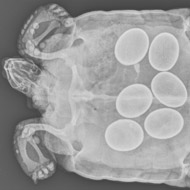
Vets find eggs in desert tortoise who was thought to be male
Exotics specialists have surgically removed inactive eggs from a 40-year-old desert tortoise.
The tortoise was brought to the UC Davis Veterinary Medical Teaching Hospital because of a decreased appetite. His owners had acquired the tortoise in 1980 and never knew the sex, so it was given a masculine name - Tiny Tim.
Diagnostic tests soon revealed that Tiny Tim was in-fact female. Six eggs could be seen in the main area of her body cavity. The shells of the eggs appeared heavily calcified and were abnormally thick, showing that they had been in the reproductive tract for a long time.
Led by Dr. David Guzman, the team of specialists began treating Tiny Tim with supportive therapy in an attempt to get her to pass the eggs naturally, including fluid injections under the skin and lukewarm water soaks.
The tortoise was then given injections of oxytocin, which increases uterine muscular contractions, so that eggs are more likely to be passed. She was also given injections of calcium and an antibiotic to prevent secondary bacterial infections.
Only three eggs passed with medical management, leaving three remaining. It was determined that Tiny Tim was not going to pass the remaining eggs at that time, so she was sent home for a week to see if the eggs would pass.
"There may have been underlying reasons why Tiny Tim wasn’t passing her eggs." says UC Davis. "One possibility was the lack of suitable places for digging burrows in which to lay the eggs. Desert tortoises dig multiple burrows as deep as 20 inches into the soil to hide their eggs. If the soil is too compact in her yard, Tiny Tim may have a tough time digging into it. Her owners dug up the earth in a few places so that the dirt was loosely packed. If she was able to dig, Tiny Tim may lay her remaining eggs and avoid surgery."
Unfortunatly Tiny Tim did not lay her eggs, so she was taken back to the hospital where she was prepared for surgery. Dr. Guzman and his team then surgically removed her ovaries, uterus and the remaining eggs.
The survey took longer than expected but was a success. "Tiny Tim made a full recovery, and will not have to worry about any potentially negative reproductive issues in the future," the hospital added.
Image (C) UC Davis


 Defra has published guidance for the vet sector ahead of a proposed UK-EU Sanitary and Phytosanitary agreement.



