Your data on MRCVSonline
The nature of the services provided by Vision Media means that we might obtain certain information about you.
Please read our Data Protection and Privacy Policy for details.

In addition, (with your consent) some parts of our website may store a 'cookie' in your browser for the purposes of
functionality or performance monitoring.
Click here to manage your settings.
If you would like to forward this story on to a friend, simply fill in the form below and click send.

Your friend's email:
Your email:
Your name:
 
 
Send Cancel

Rare heart surgery saves cat
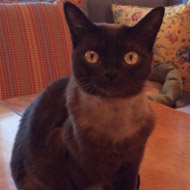
Vanilla Bean
Vanilla Bean was diagnosed with a rare congenital heart defect.

Vets and human cardiologists unite to perform surgery

Human cardiologists and vets have joined forces to perform extremely rare heart surgery on a cat.

Led by UC Davis vet Dr Josh Stern, a team of five human doctors carried out the surgery on a one-year-old female Burmese cat.

Vanilla Bean was suffering from a rare congenital heart defect that did not allow blood to flow properly through the chambers. This improper flow can cause too much blood to collect in one chamber, create pressure, enlarge it, and ultimately lead to congestive heart failure.

A procedure to correct the defect had only been reported once before by Dr Stern.

“I needed a human cardiology team to help guide me on this case, as well,” said Dr Stern. “It’s so uncommon in cats. It’s uncommon in children also, but they’ve certainly seen more cases of this than I have.”

Together, Dr Stern and the doctors opened Vanilla Bean's chest and positioned catheters and balloons within her heart.

The technique is extremely uncommon in veterinary medicine and even more rarely employed in cats due to their small size.

The surgery was a success, but not without complication -  Vanilla Bean suffered a lot of blood loss and needed several transfusions.  

Blood loss also caused Vanilla Bean to suffer an acute kidney injury, and the surgeons were concerned she would die of kidney failure. Luckily, this was not the case.  

Four months have now passed since the surgery and Vanilla Bean is no longer in congestive heart failure and has been taken off all medications. 
Dr Stern expects her to make a full recovery.

Become a member or log in to add this story to your CPD history

Equine Disease Surveillance report released for Q4 2025

News Story 1
 The latest Equine Disease Surveillance report has been released, with details on equine disease from Q4 of 2025.

The report, produced by Equine Infectious Disease Surveillance, includes advice on rule changes for equine influenza vaccination.

Statistics and maps detail recent outbreaks of equine herpes virus, equine influenza, equine strangles and equine grass sickness. A series of laboratory reports provides data on virology, bacteriology, parasitology and toxicosis.

This issue also features a case study of orthoflavivus-associated neurological disease in a horse in the UK. 

Click here for more...
News Shorts
NSA webinar explores sheep tailing and castration

The National Sheep Association (NSA) is to host a free webinar on the castration and tail docking of lambs.

The webinar, 'Understanding the tailing and castration consultation: A guide for sheep farmers', will be hosted online on Monday, 2 March 2026 at 7.30pm.

It comes during a government consultation into the methods used for these procedures. Farmers are encouraged to engage before the consultation period closes on Monday, 9 March 2026.

The webinar offers clear and actionable guidance to support farmers to contribute meaningfully to the consultation and prepare for potential changes.

On the panel will be former SVS president Kate Hovers, farmer and vet Ann Van Eetvelt and SRUC professor in Animal Health and Veterinary Sciences Cathy Dwyer. Each panel member will utilise their own specialism and expertise to evaluate risks and outcomes to sheep farming.

Find out more about the webinar on the NSA website.