
Your data on MRCVSonline
The nature of the services provided by Vision Media means that we might obtain certain information about you.
Please read our Data Protection and Privacy Policy for details.

In addition, (with your consent) some parts of our website may store a 'cookie' in your browser for the purposes of
functionality or performance monitoring.
Click here to manage your settings.
If you would like to forward this story on to a friend, simply fill in the form below and click send.

Your friend's email:
Your email:
Your name:
 
 
Send Cancel

Vets aid owners in horse weight loss study
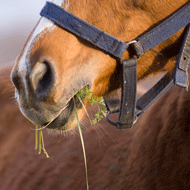
horse chewing on grass
"The study has shown how consistent, responsive support from a vet, coupled with innovative individual methods for weight loss, can make all the difference" - Celia Marr, Equine Veterinary Journal.

Diet and exercise programme key to compliance 

With encouragement from their vet, owners of overweight ponies can help to reduce the serious risks caused by obesity, according to a new study.

Research published in the Equine Veterinary Journal (EVJ) has revealed that owners of ponies with equine metabolic syndrome can, with help from their vet, implement highly effective weight loss programmes, which in turn improves insulin sensitivity and reduces the risk of laminitis.

Equine metabolic syndrome shares traits with type II diabetes in humans and is characterised in horses and ponies by obesity, insulin resistance and an increased susceptibility to laminitis.

In the study, vets at the Universities of Liverpool and Edinburgh examined nineteen horses and ponies with suspected EMS and/or a history of laminitis.

Each horse underwent clinical examinations and endocrine testing. Owners were then given individual diet and exercise plans to follow for between three and six months. They were also given daily support from vets throughout the period.

Following the treatment, the tests were repeated and the results compared to the initial assessment. All but one horse showed a significant reduction in weight, accompanying reductions in insulin levels and therefore reduced susceptibility to laminitis.

Project co-ordinator Ruth Morgan from the University of Edinburgh said: "Our weight loss work shows that if owners are educated, informed and encouraged by their vets they can effectively induce weight loss and improve insulin resistance. We found that the key to compliance is the individual tailoring of a weight loss programme for each horse."

Celia Marr, editor of the EVJ added: "We know that most owners are keen to do the best for their horses, but sometimes they lack the knowledge of facilities to implement a weight loss programme easily.

"The study has shown how consistent, responsive support from a vet, coupled with innovative individual methods for weight loss, can make all the difference."

The study is discussed in a free EVJ podcast, which is aimed at helping vets to help their clients. 

Become a member or log in to add this story to your CPD history

Equine Disease Surveillance report released for Q4 2025

News Story 1
 The latest Equine Disease Surveillance report has been released, with details on equine disease from Q4 of 2025.

The report, produced by Equine Infectious Disease Surveillance, includes advice on rule changes for equine influenza vaccination.

Statistics and maps detail recent outbreaks of equine herpes virus, equine influenza, equine strangles and equine grass sickness. A series of laboratory reports provides data on virology, bacteriology, parasitology and toxicosis.

This issue also features a case study of orthoflavivus-associated neurological disease in a horse in the UK. 

Click here for more...
News Shorts
NSA webinar explores sheep tailing and castration

The National Sheep Association (NSA) is to host a free webinar on the castration and tail docking of lambs.

The webinar, 'Understanding the tailing and castration consultation: A guide for sheep farmers', will be hosted online on Monday, 2 March 2026 at 7.30pm.

It comes during a government consultation into the methods used for these procedures. Farmers are encouraged to engage before the consultation period closes on Monday, 9 March 2026.

The webinar offers clear and actionable guidance to support farmers to contribute meaningfully to the consultation and prepare for potential changes.

On the panel will be former SVS president Kate Hovers, farmer and vet Ann Van Eetvelt and SRUC professor in Animal Health and Veterinary Sciences Cathy Dwyer. Each panel member will utilise their own specialism and expertise to evaluate risks and outcomes to sheep farming.

Find out more about the webinar on the NSA website.


