
Your data on MRCVSonline
The nature of the services provided by Vision Media means that we might obtain certain information about you.
Please read our Data Protection and Privacy Policy for details.

In addition, (with your consent) some parts of our website may store a 'cookie' in your browser for the purposes of
functionality or performance monitoring.
Click here to manage your settings.
If you would like to forward this story on to a friend, simply fill in the form below and click send.

Your friend's email:
Your email:
Your name:
 
 
Send Cancel

UK soldiers head to Gabon to tackle poaching
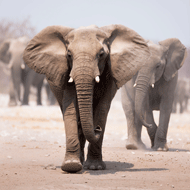
elephant
Nearly 90 per cent of Gabon is forested and highly sophisticated gangs operate under dense canopy.
Forest elephants on the brink of extinction

UK soldiers have been deployed to Gabon in West Africa to help tackle ivory poaching, which has brought the forest elephant population to the brink of extinction.

Over the past 10 years, more than 15,000 forest elephants have been killed by poachers in the Minkebe National Park alone - leaving an estimated population of just 7,000.

At the request of Gabon's president, Ali Bongo, a team of soldiers from Northern Ireland headed to a military training centre at Mokekou - which is a nine-hour drive from the nearest centre of population.

The team is drawn from a range of units, including the Rifles and Scots, to provide a range of operational skills and training to support Gabon park rangers.

Major Mark Shercliff, who is heading up the team, said he is under no illusions about the challenges ahead.

Nearly 90 per cent of Gabon is forested and highly sophisticated gangs operate under dense canopy.

"It’s a challenging environment for the Park Agencies in Gabon and for us as soldiers", he explained. "With a range of forestation across a hilly environment it is not a straightforward task."

While Major Shercliff believes military input can help on a tactical level, it cannot solve the problems on its own.

"There is a lot of work to be done above us all in the political sphere by getting countries around the world to combat poaching in a way that is joined up – this is not a phenomenon that belongs to a single country or single continent.”


Become a member or log in to add this story to your CPD history

Equine Disease Surveillance report released for Q4 2025

News Story 1
 The latest Equine Disease Surveillance report has been released, with details on equine disease from Q4 of 2025.

The report, produced by Equine Infectious Disease Surveillance, includes advice on rule changes for equine influenza vaccination.

Statistics and maps detail recent outbreaks of equine herpes virus, equine influenza, equine strangles and equine grass sickness. A series of laboratory reports provides data on virology, bacteriology, parasitology and toxicosis.

This issue also features a case study of orthoflavivus-associated neurological disease in a horse in the UK. 

Click here for more...
News Shorts
NSA webinar explores sheep tailing and castration

The National Sheep Association (NSA) is to host a free webinar on the castration and tail docking of lambs.

The webinar, 'Understanding the tailing and castration consultation: A guide for sheep farmers', will be hosted online on Monday, 2 March 2026 at 7.30pm.

It comes during a government consultation into the methods used for these procedures. Farmers are encouraged to engage before the consultation period closes on Monday, 9 March 2026.

The webinar offers clear and actionable guidance to support farmers to contribute meaningfully to the consultation and prepare for potential changes.

On the panel will be former SVS president Kate Hovers, farmer and vet Ann Van Eetvelt and SRUC professor in Animal Health and Veterinary Sciences Cathy Dwyer. Each panel member will utilise their own specialism and expertise to evaluate risks and outcomes to sheep farming.

Find out more about the webinar on the NSA website.

