Your data on MRCVSonline
The nature of the services provided by Vision Media means that we might obtain certain information about you.
Please read our Data Protection and Privacy Policy for details.

In addition, (with your consent) some parts of our website may store a 'cookie' in your browser for the purposes of
functionality or performance monitoring.
Click here to manage your settings.
If you would like to forward this story on to a friend, simply fill in the form below and click send.

Your friend's email:
Your email:
Your name:
 
 
Send Cancel

Consensus reached on jumping surfaces
Experts meeting in Lausanne
Experts met in Lausanne to discuss a standard for surfaces in equine jumping.

Global experts meet to discuss creation of a standard

A standard will be created for arena surfaces at equine jumping events, based on discussions held at a recent meeting in Switzerland.

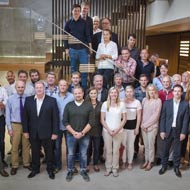
A group of 36 equine, veterinary and footing specialists from three continents met in the city of Lausanne for the two-day forum.

Their discussions will provide the framework for a surfaces standard, which is "a major step forward", said Professor Lars Roepstorff from the Swedish University of Agricultural Sciences.

The meeting took place just over a year after the publication of the Equine Surfaces White Paper, which remains the world's most extensive study of the impact of arena surfaces on equine orthopaedic health.

Delegates looked at six years' worth of research funded by the FEI - the international governing body for equestrian sports.

Included in this was research that found the performance of arena surfaces is dependent on five parameters - impact firmness, cushioning, responsiveness, grip and uniformity.

Use of the correct materials and design of surfaces, alongside proper installation and suitable maintenance, were found to be a requirement for ensuring the performance of surfaces.

Delegates agreed that these three components should evolve into standards to protect horses and riders and inform manufacturers and event organisers.

"Everyone attending the forum has practical experience of events from all over the world, and everyone voiced the need by equestrian sport to demonstrate commitment to consistent footings at major events," said Dr Mick Peterson, executive director of the Racing Surfaces Testing Laboratory.

"It is critical that we retain our momentum so that we can provide consistent surfaces for all of the major events in the next year."

Image © Greg Takatch/FEI

Become a member or log in to add this story to your CPD history

Equine Disease Surveillance report released for Q4 2025

News Story 1
 The latest Equine Disease Surveillance report has been released, with details on equine disease from Q4 of 2025.

The report, produced by Equine Infectious Disease Surveillance, includes advice on rule changes for equine influenza vaccination.

Statistics and maps detail recent outbreaks of equine herpes virus, equine influenza, equine strangles and equine grass sickness. A series of laboratory reports provides data on virology, bacteriology, parasitology and toxicosis.

This issue also features a case study of orthoflavivus-associated neurological disease in a horse in the UK. 

Click here for more...
News Shorts
NSA webinar explores sheep tailing and castration

The National Sheep Association (NSA) is to host a free webinar on the castration and tail docking of lambs.

The webinar, 'Understanding the tailing and castration consultation: A guide for sheep farmers', will be hosted online on Monday, 2 March 2026 at 7.30pm.

It comes during a government consultation into the methods used for these procedures. Farmers are encouraged to engage before the consultation period closes on Monday, 9 March 2026.

The webinar offers clear and actionable guidance to support farmers to contribute meaningfully to the consultation and prepare for potential changes.

On the panel will be former SVS president Kate Hovers, farmer and vet Ann Van Eetvelt and SRUC professor in Animal Health and Veterinary Sciences Cathy Dwyer. Each panel member will utilise their own specialism and expertise to evaluate risks and outcomes to sheep farming.

Find out more about the webinar on the NSA website.