
Your data on MRCVSonline
The nature of the services provided by Vision Media means that we might obtain certain information about you.
Please read our Data Protection and Privacy Policy for details.

In addition, (with your consent) some parts of our website may store a 'cookie' in your browser for the purposes of
functionality or performance monitoring.
Click here to manage your settings.
If you would like to forward this story on to a friend, simply fill in the form below and click send.

Your friend's email:
Your email:
Your name:
 
 
Send Cancel

Many owners uninformed about dog grooming, survey finds
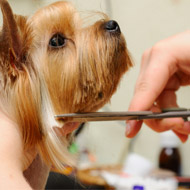
Dog grooming
73 per cent of dog groomers see breeds coming into their salon in an 'all poor' or 'mostly poor' condition.
Dog groomers raise their concerns

Many owners are uninformed about the importance of dog grooming, according to a recent poll, meaning that groomers are faced with dealing with the very real welfare problems this can cause.

The British Dog Groomers' Association (BDGA) Grooming Survey, the first of its kind, has revealed that 73 per cent of dog groomers see breeds coming into their salon in an 'all poor' or 'mostly poor' condition with matts and knots.

The majority of respondents felt that owners hadn't done enough research before purchasing a dog, with some even being told by breeders that their dog didn't need grooming.

"Dog grooming plays such an important role in keeping a dog happy and health, commented BDGA chair Stuart Simmons.  

He adds: "Apart from keeping the coat clean and free from matts, which can cause skin complaints if left, regular grooming also helps improve circulation, keeps grease levels down which can cause cysts and also allows dog groomers to do a quick health check and help to spot any early signs of illness.  It’s so much more than hairdressing for dogs!"

The survey also revealed a surge in the popularity of 'designer' dogs, with poodle cross-breeds now amongst the most popular types of dog seen in the nation's dog grooming salons.

The shih-tzu was the most popular named pedigree breed, with the cocker spaniel following closely behind.

The survey findings will be used by the BDGA and its umbrella body, the Pet Industry Federation, to help inform groomer training.  The figures will aid  discussions with education bodies and influential groups to highlight the important role that dog groomers have in maintaining the health and welfare of dogs.

To download a full report of the survey, visit www.petfederation.co.uk

Become a member or log in to add this story to your CPD history

Equine Disease Surveillance report released for Q4 2025

News Story 1
 The latest Equine Disease Surveillance report has been released, with details on equine disease from Q4 of 2025.

The report, produced by Equine Infectious Disease Surveillance, includes advice on rule changes for equine influenza vaccination.

Statistics and maps detail recent outbreaks of equine herpes virus, equine influenza, equine strangles and equine grass sickness. A series of laboratory reports provides data on virology, bacteriology, parasitology and toxicosis.

This issue also features a case study of orthoflavivus-associated neurological disease in a horse in the UK. 

Click here for more...
News Shorts
NSA webinar explores sheep tailing and castration

The National Sheep Association (NSA) is to host a free webinar on the castration and tail docking of lambs.

The webinar, 'Understanding the tailing and castration consultation: A guide for sheep farmers', will be hosted online on Monday, 2 March 2026 at 7.30pm.

It comes during a government consultation into the methods used for these procedures. Farmers are encouraged to engage before the consultation period closes on Monday, 9 March 2026.

The webinar offers clear and actionable guidance to support farmers to contribute meaningfully to the consultation and prepare for potential changes.

On the panel will be former SVS president Kate Hovers, farmer and vet Ann Van Eetvelt and SRUC professor in Animal Health and Veterinary Sciences Cathy Dwyer. Each panel member will utilise their own specialism and expertise to evaluate risks and outcomes to sheep farming.

Find out more about the webinar on the NSA website.


