Your data on MRCVSonline
The nature of the services provided by Vision Media means that we might obtain certain information about you.
Please read our Data Protection and Privacy Policy for details.

In addition, (with your consent) some parts of our website may store a 'cookie' in your browser for the purposes of
functionality or performance monitoring.
Click here to manage your settings.
If you would like to forward this story on to a friend, simply fill in the form below and click send.

Your friend's email:
Your email:
Your name:
 
 
Send Cancel

'Test tube' foals offer hope for rare breeds
Twemlows Little ICSI
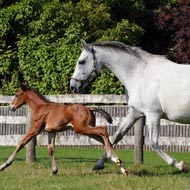
'Twemlows Little ICSI' at just one week old, with his surrogate mother Victoria.

Innovative technique allows embryos to be frozen
 
Two 'test tube' foals have been born in the UK, thanks to advanced breeding methods that could offer a lifeline to breeds facing the threat of extinction.

The births were the result of a three-year programme led by the University of Liverpool, University of Surrey and Twemlows Stud Farm in Shropshire. They aimed to establish breeding options that are not routinely available in the UK.

One of the foals - named Twemlows Simba - was the first in the UK to be born using oocyte transfer - a technique whereby eggs are collected from a donor mare and transferred to a surrogate female before fertilisation.

The second foal, Twemlows Little ICSI, was born earlier this month using an intracytoplasmic sperm injection (ICSI). This involves a single sperm being injected into an egg through a thin glass pipette, creating an embryo that is transferred to the surrogate female.

Significantly, this method allows embryos to be frozen, as well as just semen. If this can be done reliably, scientists say a breed could be resurrected in a crisis by returning the embryos to surrogate mares.

Professor Caroline Argo, the project's academic lead, explained: "At the moment, we can freeze stallion sperm reliably but not horse eggs or embryos."

Now that ICSI has proved successful, however, she said it could be used more routinely and widely for conservation purposes.

Tom Beeston, CEO of the Rare Breeds Survival Trust, said this project is the best hope for resurrecting extinct breeds.

"Breeding numbers of all our native equine breeds continue to decline," he said. "If not halted soon our gene bank may be needed to reconstitute a breed, it really is that serious."

Image courtesy of the University of Liverpool

Become a member or log in to add this story to your CPD history

Equine Disease Surveillance report released for Q4 2025

News Story 1
 The latest Equine Disease Surveillance report has been released, with details on equine disease from Q4 of 2025.

The report, produced by Equine Infectious Disease Surveillance, includes advice on rule changes for equine influenza vaccination.

Statistics and maps detail recent outbreaks of equine herpes virus, equine influenza, equine strangles and equine grass sickness. A series of laboratory reports provides data on virology, bacteriology, parasitology and toxicosis.

This issue also features a case study of orthoflavivus-associated neurological disease in a horse in the UK. 

Click here for more...
News Shorts
NSA webinar explores sheep tailing and castration

The National Sheep Association (NSA) is to host a free webinar on the castration and tail docking of lambs.

The webinar, 'Understanding the tailing and castration consultation: A guide for sheep farmers', will be hosted online on Monday, 2 March 2026 at 7.30pm.

It comes during a government consultation into the methods used for these procedures. Farmers are encouraged to engage before the consultation period closes on Monday, 9 March 2026.

The webinar offers clear and actionable guidance to support farmers to contribute meaningfully to the consultation and prepare for potential changes.

On the panel will be former SVS president Kate Hovers, farmer and vet Ann Van Eetvelt and SRUC professor in Animal Health and Veterinary Sciences Cathy Dwyer. Each panel member will utilise their own specialism and expertise to evaluate risks and outcomes to sheep farming.

Find out more about the webinar on the NSA website.