
Your data on MRCVSonline
The nature of the services provided by Vision Media means that we might obtain certain information about you.
Please read our Data Protection and Privacy Policy for details.

In addition, (with your consent) some parts of our website may store a 'cookie' in your browser for the purposes of
functionality or performance monitoring.
Click here to manage your settings.
If you would like to forward this story on to a friend, simply fill in the form below and click send.

Your friend's email:
Your email:
Your name:
 
 
Send Cancel

Herpes virus discovered at National Stud
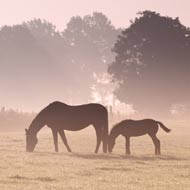
Grazing horses
Staff identified the EHV-1 virus in a maiden filly which was imported from France on 20 January.

Breeding site closed until further notice
 
A case of neurological equine herpes has been discovered in the Health Isolation Unit at The National Stud, forcing the breeding site to close.

Staff identified the EHV-1 virus in a maiden filly which was imported from France on 20 January. The horse is fully vaccinated.

Based on the outskirts of Newmarket, the National Stud is home to five stallions including Dick Turpin, Gregorian, and Toronado.

Speaking to BBC Radio Cambridgeshire, managing director Brian O’Rouke said: "This is an isolation unit and we've taken every necessary precaution.

"That one isolation unit is shut down for 30 days automatically. The staff at the unit do not go to the main farm, which is a good mile and a half from the isolation unit.

"We are hopeful that if we have no more setbacks, hopefully with consultation with a team of vets and the Animal Health Trust, we've got a second gate that we might be able to open up the stud in time for the start of the breeding season around 15 February.

"With having 3,000 racehorses on our doorstep in Newmarket, six stallion stations and all those having a lot of mares coming in from overseas and domestically, we have to be seen to set the standard."

The National Stud say that they are now closed to the public until further notice.

In response to the discovery, BEVA quickly issued a statement describing the situation as "a highly infectious disease."

"We have to take every precaution possible and we did that and did it quickly," they said.

"The case and contacts are restricted to the isolation unit which is a long distance from the remainder of the stud. Control measures are being followed in accordance with the HBLB Codes of Practice."


 

Become a member or log in to add this story to your CPD history

Equine Disease Surveillance report released for Q4 2025

News Story 1
 The latest Equine Disease Surveillance report has been released, with details on equine disease from Q4 of 2025.

The report, produced by Equine Infectious Disease Surveillance, includes advice on rule changes for equine influenza vaccination.

Statistics and maps detail recent outbreaks of equine herpes virus, equine influenza, equine strangles and equine grass sickness. A series of laboratory reports provides data on virology, bacteriology, parasitology and toxicosis.

This issue also features a case study of orthoflavivus-associated neurological disease in a horse in the UK. 

Click here for more...
News Shorts
NSA webinar explores sheep tailing and castration

The National Sheep Association (NSA) is to host a free webinar on the castration and tail docking of lambs.

The webinar, 'Understanding the tailing and castration consultation: A guide for sheep farmers', will be hosted online on Monday, 2 March 2026 at 7.30pm.

It comes during a government consultation into the methods used for these procedures. Farmers are encouraged to engage before the consultation period closes on Monday, 9 March 2026.

The webinar offers clear and actionable guidance to support farmers to contribute meaningfully to the consultation and prepare for potential changes.

On the panel will be former SVS president Kate Hovers, farmer and vet Ann Van Eetvelt and SRUC professor in Animal Health and Veterinary Sciences Cathy Dwyer. Each panel member will utilise their own specialism and expertise to evaluate risks and outcomes to sheep farming.

Find out more about the webinar on the NSA website.

