
Your data on MRCVSonline
The nature of the services provided by Vision Media means that we might obtain certain information about you.
Please read our Data Protection and Privacy Policy for details.

In addition, (with your consent) some parts of our website may store a 'cookie' in your browser for the purposes of
functionality or performance monitoring.
Click here to manage your settings.
If you would like to forward this story on to a friend, simply fill in the form below and click send.

Your friend's email:
Your email:
Your name:
 
 
Send Cancel

Cattle farmers warned about silage eye
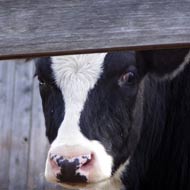
cow
Silage eye, or bovine iritis, is a common cause of inflammation of the uvea in cattle that are fed winter rations of baled silage/haylage.
Vets report a number of cases of infection

Recent wet weather may be behind a number of new cases of silage eye in cattle, according to vets at Synergy Farm Health in Dorset, who are urging farmers to be vigilant for symptoms.

Veterinary surgeon Esme Moffett told Farmers Weekly: "This is not exactly a common condition, but one I have seen in several animals in recent weeks.

"Mould in feed and bedding can cause the condition, so it is wise for farmers to keep a lookout to help both prevent and treat the condition early."

Silage eye, or bovine iritis, is a common cause of inflammation of the uvea - the pigmented layer of the eye beneath the sclera and cornea - in cattle that are fed winter rations of baled silage/haylage.

Farmers are being urged to look out for early signs of squinting and watery or cloudy eyes, as the condition responds well to antibiotic eye cream at this stage. If infection is picked up at a later stage, farmers are advised to call their vet.

"As always, prevention is better than cure, so look out for mouldy lumps of feed and bedding and get rid of them," Mrs Moffett added.

Other signs of silage eye include blinking, forced closure of eyelids, excessive tear staining, bulges in the iris and bluish-white opacity of the eye surface.


Become a member or log in to add this story to your CPD history

Submissions open for BSAVA Clinical Research Abstracts 2026

News Story 1
 The BSAVA has opened submissions for the BSAVA Clinical Research Abstracts 2026.

It is an opportunity for applicants to present new research on any veterinary subject, such as the preliminary results of a study, discussion of a new technique or a description of an interesting case.

They must be based on high-quality clinical research conducted in industry, practice or academia, and summarised in 250 words.

Applications are welcome from vets, vet nurses, practice managers, and students.

Submissions are open until 6 March 2026. 

Click here for more...
News Shorts
Survey seeks ruminant sector views on antimicrobial stewardship

A new survey is seeking views of people working in the UK ruminant sector on how to tackle the challenge of demonstrating responsible antibiotic stewardship.

Forming part of a wider, collaborative initiative, the results will help identify the types of data available so that challenges with data collection can be better understood and addressed.

Anyone working in the UK farming sector, including vets and farmers,is encouraged to complete the survey, which is available at app.onlinesurveys.jisc.ac.uk

