
Your data on MRCVSonline
The nature of the services provided by Vision Media means that we might obtain certain information about you.
Please read our Data Protection and Privacy Policy for details.

In addition, (with your consent) some parts of our website may store a 'cookie' in your browser for the purposes of
functionality or performance monitoring.
Click here to manage your settings.
If you would like to forward this story on to a friend, simply fill in the form below and click send.

Your friend's email:
Your email:
Your name:
 
 
Send Cancel

Gastric ulcer risk with low fibre diets, nutritionists warn
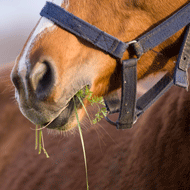
horse eating
Horses on a restricted forage diet with nothing to eat for long periods are prone to developing gastric ulcers.
Up to 60 per cent of horses affected, according to some competition studies

Competition horses are at risk of gastric ulcers if their forage is restricted in favour of high energy cereals, a feed company has warned.

The energy supplied by forage alone is often not enough for the work horses are required to do and, as a result, they may be fed less forage and more high energy feedstuffs, such as cereals.

But studies have shown that, in some competition disciplines, up to 60 per cent of horses are affected by gastric ulcers.

Horses are evolved to spend up to 18 hours per day eating and 65 per cent of the gut is devoted to digesting fibre, nutritionists at Winergy say.

The stomach produces acid continually, but horses can only produce acid-neutralising saliva when they chew. Therefore, those on a restricted forage diet with nothing to eat for long periods are prone to developing gastric ulcers. High cereal meals may also increase the risk due to excess fermentation in the stomach.

Exercise may make the problem worse by increasing gastric acid production, as it increases pressure in the abdomen, resulting in more gastric acid splashing onto the upper part of the stomach.

Winergy nutritionist Clare Barfoot advised owners not to leave horses for more than six hours without forage. "It’s also best to restrict starch intake to less than 2g/kg bodyweight per day," she added.

"Adding chopped fibre, particularly alfalfa, is also helpful. It will extend eating time and the high protein and calcium content may help to buffer stomach acid to help maintain a fibre mat in the stomach to help to prevent 'gastric splashing'."

Become a member or log in to add this story to your CPD history

Equine Disease Surveillance report released for Q4 2025

News Story 1
 The latest Equine Disease Surveillance report has been released, with details on equine disease from Q4 of 2025.

The report, produced by Equine Infectious Disease Surveillance, includes advice on rule changes for equine influenza vaccination.

Statistics and maps detail recent outbreaks of equine herpes virus, equine influenza, equine strangles and equine grass sickness. A series of laboratory reports provides data on virology, bacteriology, parasitology and toxicosis.

This issue also features a case study of orthoflavivus-associated neurological disease in a horse in the UK. 

Click here for more...
News Shorts
NSA webinar explores sheep tailing and castration

The National Sheep Association (NSA) is to host a free webinar on the castration and tail docking of lambs.

The webinar, 'Understanding the tailing and castration consultation: A guide for sheep farmers', will be hosted online on Monday, 2 March 2026 at 7.30pm.

It comes during a government consultation into the methods used for these procedures. Farmers are encouraged to engage before the consultation period closes on Monday, 9 March 2026.

The webinar offers clear and actionable guidance to support farmers to contribute meaningfully to the consultation and prepare for potential changes.

On the panel will be former SVS president Kate Hovers, farmer and vet Ann Van Eetvelt and SRUC professor in Animal Health and Veterinary Sciences Cathy Dwyer. Each panel member will utilise their own specialism and expertise to evaluate risks and outcomes to sheep farming.

Find out more about the webinar on the NSA website.

