
Your data on MRCVSonline
The nature of the services provided by Vision Media means that we might obtain certain information about you.
Please read our Data Protection and Privacy Policy for details.

In addition, (with your consent) some parts of our website may store a 'cookie' in your browser for the purposes of
functionality or performance monitoring.
Click here to manage your settings.
If you would like to forward this story on to a friend, simply fill in the form below and click send.

Your friend's email:
Your email:
Your name:
 
 
Send Cancel

Post-movement testing begins in April
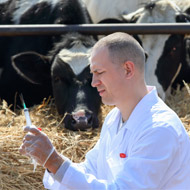
Injection
Over half of new bovine TB infections in low risk areas are connected to cattle purchased from high risk areas.

Further measures announced to protect England from TB

Compulsory post-movement testing is to be introduced from April 6 2016 as part of a package of measures to eradicate TB in England.

Over half of new bovine TB infections in low risk areas are connected to cattle purchased from high risk areas.

It is hoped the move will give farmers great confidence that low risk areas can officially become TB-free.

At the same time, following consultation last year, the Government will introduce a further three additional measures.

These include tighter movement restrictions, Government-funded pre-sale testing, and the option of APHA private Interferon gamma blood tests to diagnose TB under certain conditions.

Commenting on the new measures farming minister George Eustice said: “We are presiding over a huge collective effort to eradicate bovine TB in England.

“Our comprehensive strategy is clear: the disease can only be defeated by taking coordinated action on cattle movements, cattle testing and badger control.

“The cattle measures we are introducing in April will help protect against cattle-to-cattle transmission and bring the Low Risk Area closer to achieving TB freedom.” 

It has been three years since the Government first announced its TB eradication strategy which includes tighter cattle measures, improved biosecurity and badger control.

Supported by leading vets and Defra scientists, the Government say that the approach of dealing with the disease in cattle and wildlife has worked overseas.


Become a member or log in to add this story to your CPD history

Submissions open for BSAVA Clinical Research Abstracts 2026

News Story 1
 The BSAVA has opened submissions for the BSAVA Clinical Research Abstracts 2026.

It is an opportunity for applicants to present new research on any veterinary subject, such as the preliminary results of a study, discussion of a new technique or a description of an interesting case.

They must be based on high-quality clinical research conducted in industry, practice or academia, and summarised in 250 words.

Applications are welcome from vets, vet nurses, practice managers, and students.

Submissions are open until 6 March 2026. 

Click here for more...
News Shorts
Survey seeks ruminant sector views on antimicrobial stewardship

A new survey is seeking views of people working in the UK ruminant sector on how to tackle the challenge of demonstrating responsible antibiotic stewardship.

Forming part of a wider, collaborative initiative, the results will help identify the types of data available so that challenges with data collection can be better understood and addressed.

Anyone working in the UK farming sector, including vets and farmers,is encouraged to complete the survey, which is available at app.onlinesurveys.jisc.ac.uk

