
Your data on MRCVSonline
The nature of the services provided by Vision Media means that we might obtain certain information about you.
Please read our Data Protection and Privacy Policy for details.

In addition, (with your consent) some parts of our website may store a 'cookie' in your browser for the purposes of
functionality or performance monitoring.
Click here to manage your settings.
If you would like to forward this story on to a friend, simply fill in the form below and click send.

Your friend's email:
Your email:
Your name:
 
 
Send Cancel

Faster diagnosis for oedema disease a possibility
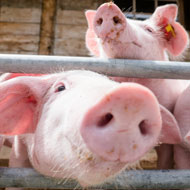
pig
The study involved 20 pigs from 14 commercial farms from which faecal swabs were subjected to the PCR test.
Scientists trial PCR test on pig faeces

Scientists in Germany have conducted a study on the PCR test to see if there is a faster way to diagnose oedema disease in pigs.

The study involves taking samples direct from the faeces instead of waiting for post-mortem tests on tissues.

According to veterinary surgeon Dr Vera Gotter from IDT Biologica, early results are ‘promising', and could lead to a quicker, easier - and possibly cheaper - method of diagnosing the disease in the future.

“The PCR tests from faeces could make the analysis of the disease quicker and less expensive because the piglets would not have to be submitted to a post-mortem examination anymore,” explains Dr Gotter.

“The test is not 100 per cent accurate but neither are the current ones. While the initial results are promising they should not be over-estimated. Further studies involving more pigs should be carried out.”

The study involved 20 pigs from 14 commercial farms from which faecal swabs were subjected to the PCR test. This was then compared with the results from histopathology involving samples from the brain, spinal cord and intestine.

Oedema disease is an often-fatal disease that occurs primarily in recently weaned pigs. It is caused by certain serotypes of E.coli bacteria that produce a powerful toxin and is difficult to diagnose on farm.


Become a member or log in to add this story to your CPD history

Submissions open for BSAVA Clinical Research Abstracts 2026

News Story 1
 The BSAVA has opened submissions for the BSAVA Clinical Research Abstracts 2026.

It is an opportunity for applicants to present new research on any veterinary subject, such as the preliminary results of a study, discussion of a new technique or a description of an interesting case.

They must be based on high-quality clinical research conducted in industry, practice or academia, and summarised in 250 words.

Applications are welcome from vets, vet nurses, practice managers, and students.

Submissions are open until 6 March 2026. 

Click here for more...
News Shorts
Survey seeks ruminant sector views on antimicrobial stewardship

A new survey is seeking views of people working in the UK ruminant sector on how to tackle the challenge of demonstrating responsible antibiotic stewardship.

Forming part of a wider, collaborative initiative, the results will help identify the types of data available so that challenges with data collection can be better understood and addressed.

Anyone working in the UK farming sector, including vets and farmers,is encouraged to complete the survey, which is available at app.onlinesurveys.jisc.ac.uk

