Your data on MRCVSonline
The nature of the services provided by Vision Media means that we might obtain certain information about you.
Please read our Data Protection and Privacy Policy for details.

In addition, (with your consent) some parts of our website may store a 'cookie' in your browser for the purposes of
functionality or performance monitoring.
Click here to manage your settings.
If you would like to forward this story on to a friend, simply fill in the form below and click send.

Your friend's email:
Your email:
Your name:
 
 
Send Cancel

Wearable tech for racehorses could reduce fatalities
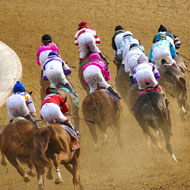
horse
The device records information about the animal's movement, such as speed and acceleration.
Equimètre sensor may catch injuries like bucked shins

A wearable device that monitors a horse’s physical well-being during a race could help to prevent fatal injuries.

According to New Scientist, the Equimètre sensor, developed by Arioneo in Paris, France, is designed to reduce fatalities, prevent injury and help trainers sharpen a horse’s performance.

The sensor fits into the girth - a strap around the horse’s middle that keeps the saddle on. This records physiological data like temperature, heart and respiratory rate which can be viewed in real time via an app.

The device also records information about the animal's movement, such as speed and acceleration, and monitors environmental conditions, like humidity.

The manufacturers say that the Equimètre differs to other smart devices that capture similar data, because it runs the stats through algorithms. These are then compared with past performances.
 
“A trainer’s eye is very important and we do not want to replace their expertise,” says Arioneo co-founder Valentin Rapin. “This tool will give trainers information they don’t have today.”

For example, instead of the showing an increase in heart rate, the Equimètre device can put this into context and tell the trainer what it means for that particular horse in those particular conditions. “It can prevent overtraining,” adds Rapin.

It is hoped the device will catch injuries like bucked shins. Affecting around 70 per cent of young thoroughbreds, bucked shins can lead to stress fractures, which often result in a horse being killed.

Welcoming the device, horse vet Hervé Moreau from La Ferté-Saint-Cyr, France, said: "The early detection of locomotion problems can only improve diagnosis. Similarly, optimising the training programme will reduce the risk of stress factors.”

 

Become a member or log in to add this story to your CPD history

Equine Disease Surveillance report released for Q4 2025

News Story 1
 The latest Equine Disease Surveillance report has been released, with details on equine disease from Q4 of 2025.

The report, produced by Equine Infectious Disease Surveillance, includes advice on rule changes for equine influenza vaccination.

Statistics and maps detail recent outbreaks of equine herpes virus, equine influenza, equine strangles and equine grass sickness. A series of laboratory reports provides data on virology, bacteriology, parasitology and toxicosis.

This issue also features a case study of orthoflavivus-associated neurological disease in a horse in the UK. 

Click here for more...
News Shorts
NSA webinar explores sheep tailing and castration

The National Sheep Association (NSA) is to host a free webinar on the castration and tail docking of lambs.

The webinar, 'Understanding the tailing and castration consultation: A guide for sheep farmers', will be hosted online on Monday, 2 March 2026 at 7.30pm.

It comes during a government consultation into the methods used for these procedures. Farmers are encouraged to engage before the consultation period closes on Monday, 9 March 2026.

The webinar offers clear and actionable guidance to support farmers to contribute meaningfully to the consultation and prepare for potential changes.

On the panel will be former SVS president Kate Hovers, farmer and vet Ann Van Eetvelt and SRUC professor in Animal Health and Veterinary Sciences Cathy Dwyer. Each panel member will utilise their own specialism and expertise to evaluate risks and outcomes to sheep farming.

Find out more about the webinar on the NSA website.