
Your data on MRCVSonline
The nature of the services provided by Vision Media means that we might obtain certain information about you.
Please read our Data Protection and Privacy Policy for details.

In addition, (with your consent) some parts of our website may store a 'cookie' in your browser for the purposes of
functionality or performance monitoring.
Click here to manage your settings.
If you would like to forward this story on to a friend, simply fill in the form below and click send.

Your friend's email:
Your email:
Your name:
 
 
Send Cancel

RSPB withdraws from hen harrier project
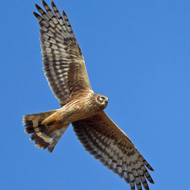
hen harrier
The charity is convinced that the main reason for the hen harrier's scarcity is illegal killing.
Charity says licensing of grouse shooting estates is the 'only viable option'
 
The RSPB has withdrawn its support for Defra's Hen Harrier Action Plan, saying its voluntary approach has been unsuccessful. The charity is now calling for grouse shooting estates to be licensed in order to tackle the illegal killing of birds of prey.

Defra's action plan was developed to boost England's population of hen harriers, but last year the RSPB said there were just six successful hen harrier nests from 12 attempts. In a blog post this week, RSPB's conservation director Martin Harper said 2016 is set to be far worse, with only three nests so far.

The charity is convinced that the main reason for the hen harrier's scarcity is illegal killing, associated with land managed intensively for grouse shooting. Early results from the national hen harrier survey suggest the species is doing better away from intensively managed grouse moors in north and west Scotland, Mr Harper added.

There have been a number of incidents in England and Scotland this year, including the disappearance of the hen harriers 'Chance' and 'Highlander' and several suspicious red kite deaths in Yorkshire. Together with recent cases involving pole traps, as well as a 'decoy bird' to attract hen harriers, it's clear that some people are still breaking the law and a different approach is needed to tackle this illegal activity.

The RSPB believes reform can only come from the licensing of grouse shooting, as this would mean shoots could be banned if birds of prey are killed illegally. Mr Harper says the charity will continue to work with partners on the ground, including raptor workers, landowners who wish to cooperate, the public and the police.


Become a member or log in to add this story to your CPD history

Equine Disease Surveillance report released for Q4 2025

News Story 1
 The latest Equine Disease Surveillance report has been released, with details on equine disease from Q4 of 2025.

The report, produced by Equine Infectious Disease Surveillance, includes advice on rule changes for equine influenza vaccination.

Statistics and maps detail recent outbreaks of equine herpes virus, equine influenza, equine strangles and equine grass sickness. A series of laboratory reports provides data on virology, bacteriology, parasitology and toxicosis.

This issue also features a case study of orthoflavivus-associated neurological disease in a horse in the UK. 

Click here for more...
News Shorts
RCVS annual renewal fee for vets due

RCVS' annual renewal fee for veterinary surgeons is now due. Vets must pay their renewal fee before Wednesday, 1 April 2026.

This year's standard annual fee has increased to 431 from last year's 418. This is an approximately three per cent increase, as approved by RCVS Council and the Privy Council.

Tshidi Gardner, RCVS treasurer, said: "The small fee increase will be used to help deliver both our everyday activities and our new ambitious Strategic Plan, which includes aims such as achieving new legislation, reviewing the Codes of Professional Conduct and supporting guidance, and continuing to support the professions through activities such as the Mind Matters Initiative, RCVS Academy and career development."

A full breakdown of the new fees is on the RCVS website. Information about tax relief is available on the UK government website.

