
Your data on MRCVSonline
The nature of the services provided by Vision Media means that we might obtain certain information about you.
Please read our Data Protection and Privacy Policy for details.

In addition, (with your consent) some parts of our website may store a 'cookie' in your browser for the purposes of
functionality or performance monitoring.
Click here to manage your settings.
If you would like to forward this story on to a friend, simply fill in the form below and click send.

Your friend's email:
Your email:
Your name:
 
 
Send Cancel

Rio horse clinic 'like no other'
Dr Thomas Wolff
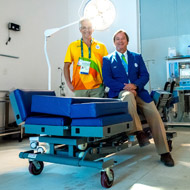
Brazil’s Dr Thomas Wolff (right) leads a 130-strong team of veterinary experts, including leading surgeon Carlos Eduardo Veiga (left).

Olympic vets will care for over 200 horses

Horses taking part in Rio 2016 will receive first-class care at a veterinary facility ‘like-no-other’.


According to the FEI, the 1,000 square meter horse clinic features everything needed to keep over 200 horses from 43 countries in top condition throughout the Olympic Games.


Located at the Deodoro stables, the clinic is manned by a 130-strong team of veterinary experts from across the world.


As well as the latest radiography, pathology and endoscopy technology, the clinic also includes a dispensary, specialist treatment stables and a surgery facility with padded recovery boxes.


“Our horses always deserve the very best, and at these first games in South America, they’re getting just that," said Brazil’s Dr Thomas Wolff, President of the Rio 2016 Olympic and Paralympic Veterinary Commission.  

He adds: "We know everything about every horse on site every second of the day thanks to our monitoring system, and with the world’s best veterinary care on offer for our horses we’re now very much looking forward to seeing medals won and new Olympic records set in Rio.”

Keeping horses cool will be a major focus for the veterinary team.
Every day, over 46,000 litres of water and 400kg of ice to chill the water will be used across the Olympic Equestrian Centre just for washing down horses after training and competition. 


Tents containing cooling fans will also be available next to the training and warm-up arenas for jumping and dressage.

Image (C) Arnd Bronkhorst/FEI

Become a member or log in to add this story to your CPD history

Equine Disease Surveillance report released for Q4 2025

News Story 1
 The latest Equine Disease Surveillance report has been released, with details on equine disease from Q4 of 2025.

The report, produced by Equine Infectious Disease Surveillance, includes advice on rule changes for equine influenza vaccination.

Statistics and maps detail recent outbreaks of equine herpes virus, equine influenza, equine strangles and equine grass sickness. A series of laboratory reports provides data on virology, bacteriology, parasitology and toxicosis.

This issue also features a case study of orthoflavivus-associated neurological disease in a horse in the UK. 

Click here for more...
News Shorts
NSA webinar explores sheep tailing and castration

The National Sheep Association (NSA) is to host a free webinar on the castration and tail docking of lambs.

The webinar, 'Understanding the tailing and castration consultation: A guide for sheep farmers', will be hosted online on Monday, 2 March 2026 at 7.30pm.

It comes during a government consultation into the methods used for these procedures. Farmers are encouraged to engage before the consultation period closes on Monday, 9 March 2026.

The webinar offers clear and actionable guidance to support farmers to contribute meaningfully to the consultation and prepare for potential changes.

On the panel will be former SVS president Kate Hovers, farmer and vet Ann Van Eetvelt and SRUC professor in Animal Health and Veterinary Sciences Cathy Dwyer. Each panel member will utilise their own specialism and expertise to evaluate risks and outcomes to sheep farming.

Find out more about the webinar on the NSA website.


