
Your data on MRCVSonline
The nature of the services provided by Vision Media means that we might obtain certain information about you.
Please read our Data Protection and Privacy Policy for details.

In addition, (with your consent) some parts of our website may store a 'cookie' in your browser for the purposes of
functionality or performance monitoring.
Click here to manage your settings.
If you would like to forward this story on to a friend, simply fill in the form below and click send.

Your friend's email:
Your email:
Your name:
 
 
Send Cancel

Study reveals gaited horses originate in medieval England
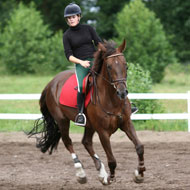
Horse and rider
The study suggest gaited horses were imported to Iceland where they were selectively bred for their trait.

Vikings responsible for starting worldwide distribution 

A study by an international research team working under Leibniz Institute for Zoo and Wildlife Research (IZW) in Berlin has revealed the probable origins and development of the worldwide population of gaited horses.  

A mutation of the DMRT3 gene was identified as responsible for the more comfortable ambling or pacing gait typical of Icelandic horses, giving a smoother ride particularly suitable for long distances and rough terrain.

To trace the origins of the gaited horse, scientists analysed the genome of 90 horses from the Copper Age (6000 BC) to the Middle Ages (11th century).  The mutation was found in samples of two medieval English horses, along with several Icelandic horses dating from the 9th-11th century. The mutation was not found in any other European, or Asian horses from the same time period.

As it is extremely unlikely that the two populations of horses developed the mutation independently, the suggestion is that the gaited horses were imported to Iceland where they were selectively bred for their trait.

Arne Ludwig, geneticist at IZW explains “The Vikings recognised the value of the gaited horses and preferentially selected this trait- thereby laying the foundation for the worldwide distribution.”

Records of Vikings pillaging in the region of today’s Yorkshire, where the two positive English samples originated from, combined with sagas suggesting Icelandic horses exhibited gaited horse traits early on, Ludwig and his team have concluded that “results suggest that Vikings first encountered gaited horses on the British Isles and transported them to Iceland.”

Become a member or log in to add this story to your CPD history

Submissions open for BSAVA Clinical Research Abstracts 2026

News Story 1
 The BSAVA has opened submissions for the BSAVA Clinical Research Abstracts 2026.

It is an opportunity for applicants to present new research on any veterinary subject, such as the preliminary results of a study, discussion of a new technique or a description of an interesting case.

They must be based on high-quality clinical research conducted in industry, practice or academia, and summarised in 250 words.

Applications are welcome from vets, vet nurses, practice managers, and students.

Submissions are open until 6 March 2026. 

Click here for more...
News Shorts
Survey seeks ruminant sector views on antimicrobial stewardship

A new survey is seeking views of people working in the UK ruminant sector on how to tackle the challenge of demonstrating responsible antibiotic stewardship.

Forming part of a wider, collaborative initiative, the results will help identify the types of data available so that challenges with data collection can be better understood and addressed.

Anyone working in the UK farming sector, including vets and farmers,is encouraged to complete the survey, which is available at app.onlinesurveys.jisc.ac.uk

