


Pet trade 'pushing African greys to extinction'
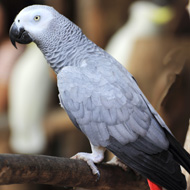
"If we're not careful, the African grey parrot will dwindle into history."
Removal from the wild is pushing African grey parrots to the brink of extinction, prompting calls to ban their international commercial trade.
While the species once ranged across Africa's equatorial region, the Cornell Lab of Ornithology says it is now classed as either extremely rare or locally extinct in several of its range states, such as Guinea, Guinea-Bissau, Togo, Benin, Rwanda, Burundi, Tanzania and Kenya.
According to a hard-hitting Youtube video posted by the lab, the species decline is most evident in Ghana. Conservation biologist Dr Nathaniel Annorbah says the country's population has fallen by a staggering 90-95 per cent in the past 20 to 25 years alone.
This dire situation is not unique to Ghana and similar declines can be seen in neighbouring countries. Where healthy populations remain, birds are being captured from the wild to supply the legal and illegal international trade.
Legal exports of African grey parrots number 1.3 million since 1975. But the figure does not include deaths in transit. Pre-export mortality rates are said to be 30-60 per cent, or up to 90 per cent. A conservative estimate for exports including mortalities is 2.1-2.5 million. On top of that, the illegal trade drives numbers still higher.
As the supply of birds is depleted in many countries, poaching pressure rises in others. Gabon, for example, has seen a major increase in poaching in the last four to five years.
The illegal trade is so widespread and organised that attempts to address it have failed. Dr Annorbah says that while many member states adhere to export quotas, criminal networks exploit authorised trade to mask illegal shipments. Corrupt officials take advantage of the system and wild caught birds are exported under the guise of captive animals.
Conservationists fear the species could go the way of the Carolina parakeet, which used to range across two-thirds of the US until the population was exhausted by removal from the wild in less than 50 years.
Big roosts of African greys are gradually becoming a thing of the past and the big flocks are disappearing. Professor Lee White, director of the Gabonese National Parks Agency, says: "If we're not careful, the African grey parrot will dwindle into history."
There is a need for effective regulations with international support to reserve the declines.
This autumn a CITES Conference of the Parties meeting will see parties consider a proposal to transfer the African grey parrot from Appendix II to Appendix I, which would effectively ban its international commercial trade.


 BVA has announced a new series of its Building Great Workplaces lunchtime webinars.



