


Project seeks to help victims of boat collisions
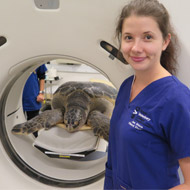
The RVC has joined forces with Weymouth Sea Life Park to offer a pioneering CT scan programme for sea turtles.
Every year, dozens of sea turtles are taken in by a Florida rescue centre following collisions with boats in Florida Keys. A few of these turtles suffer chronic spinal inquiries and lose their ability to dive without the aid of special weights.
Six years ago, Weymouth Sea Life Park in Dorset gave five victims a home. During their stay, consultant vet Sue Thornton organised a CT scan at the RVC for one of the turtles, ‘Ali’.
The scan confirmed Ali was suffering progressive and untreatable bone disease which unfortunately left no other option but to euthanize.
However, this visit led to a pioneering collaboration by alerting final year RVC veterinary student Jen Oraze - also a marine biology graduate from the University of California, Santa Cruz - to the potential benefits of CT scans for other collision victims.
Keen to find out if they could save the other the turtles, Weymouth Sea Life Park and Jen arranged visits to the RVC for similarly disabled green turtles Gumbo, Sharky, Josie and Cracker.
Green turtle Gulliver, thought to be more than 70 years old, also made a trip from Brighton Sea Life Centre and his scan was used for diagnostic purposes to examine a soft shell. This provided Jen with data on an animal without spinal damage for handy comparison.
The spine-damaged turtles are the main focus of Jen’s study, and she aims to report on her findings next month.
As a marine-life enthusiast with a particular fondness for sea turtles, Jen says that she is thrilled to be able to work with these iconic sea creatures during her fifth and final year of training.
“The data gathered from the scans and neurological examinations will hopefully provide more insight into the nature and extent of these turtles’ disabilities,” she said. “What I learn should help Sea Life to improve the quality of care it provides, and may also enable the team in Florida to more accurately diagnose the problems that newly rescued collision victims will suffer.”
Image (C) RVC


 Defra has published guidance for the vet sector ahead of a proposed UK-EU Sanitary and Phytosanitary agreement.



