Your data on MRCVSonline
The nature of the services provided by Vision Media means that we might obtain certain information about you.
Please read our Data Protection and Privacy Policy for details.

In addition, (with your consent) some parts of our website may store a 'cookie' in your browser for the purposes of
functionality or performance monitoring.
Click here to manage your settings.
If you would like to forward this story on to a friend, simply fill in the form below and click send.

Your friend's email:
Your email:
Your name:
 
 
Send Cancel

Breakthrough in ‘shaking piglets’ puzzle
piglets
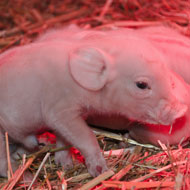
Congenital tremors cause mortality of up to 30 per cent in affected piglets.

Tremors in newborns down to viral infection - study

Shaking and tremors in newborn piglets are down to a specific viral infection that could be sexually transmitted, scientists have confirmed for the first time.

‘Shaking piglet’ cases have been reported in Europe and elsewhere since the 1920s, but until now, the cause was unconfirmed.

Scientists at Vetmeduni Vienna were able to detect an atypical porcine pestivirus (APPV) in Austrian piglets with congenital tremors, using a newly developed test. They say it is the first time this correlation has been proved, representing an important breakthrough. The findings were published in the journal Veterinary Research.

The test confirmed high numbers of the virus in diseased piglets, and also in the saliva and semen of adult pigs. Co first author Christiane Riedel from the Institute of Virology, commented: “The presence of the virus in the semen of a mature boar sheds new light on how the pathogen may be spread.

“The virus appears to persist in some animals even without symptoms. We detected the pathogen in the semen of a former shaking piglet, which shows that the disease may be transmitted sexually.”

It is thought likely that the virus is transmitted to piglets at a stage of gestation when the central nervous system is developing.

Congenital tremors cause mortality of up to 30 per cent in affected piglets. Depending on the severity, they can prevent newborns from suckling milk properly, which is particularly significant in the first 24 hours after birth.

Lead author Lukas Schwarz, veterinary clinician at the University Clinic for Swine, explained: “Without the first drink of mother’s milk, piglets have a very low chance of survival.”

For piglets who survive this first phase, symptoms generally recede after three or four weeks. Rarely, a slight tremor may remain in the ears. But it requires huge amounts of care and attention from vets and farmers to get piglets this far.

Image © Michael Bernkopf/Vetmeduni Vienna

 

Become a member or log in to add this story to your CPD history

Equine Disease Surveillance report released for Q4 2025

News Story 1
 The latest Equine Disease Surveillance report has been released, with details on equine disease from Q4 of 2025.

The report, produced by Equine Infectious Disease Surveillance, includes advice on rule changes for equine influenza vaccination.

Statistics and maps detail recent outbreaks of equine herpes virus, equine influenza, equine strangles and equine grass sickness. A series of laboratory reports provides data on virology, bacteriology, parasitology and toxicosis.

This issue also features a case study of orthoflavivus-associated neurological disease in a horse in the UK. 

Click here for more...
News Shorts
NSA webinar explores sheep tailing and castration

The National Sheep Association (NSA) is to host a free webinar on the castration and tail docking of lambs.

The webinar, 'Understanding the tailing and castration consultation: A guide for sheep farmers', will be hosted online on Monday, 2 March 2026 at 7.30pm.

It comes during a government consultation into the methods used for these procedures. Farmers are encouraged to engage before the consultation period closes on Monday, 9 March 2026.

The webinar offers clear and actionable guidance to support farmers to contribute meaningfully to the consultation and prepare for potential changes.

On the panel will be former SVS president Kate Hovers, farmer and vet Ann Van Eetvelt and SRUC professor in Animal Health and Veterinary Sciences Cathy Dwyer. Each panel member will utilise their own specialism and expertise to evaluate risks and outcomes to sheep farming.

Find out more about the webinar on the NSA website.