


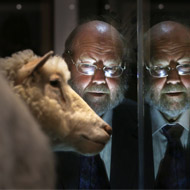
Scientists reflect on Dolly’s scientific legacy
Twenty years after Dolly the sheep hit the headlines, scientists at the Roslin Institute have been reflecting on her scientific legacy.
Dolly was part of a series of experiments at the Roslin Institute trying to develop a better method for producing genetically modified livestock.
The researchers hoped to reduce the number of animals being used in experiments and learn more about how cells change during development. They also sought to find out whether a specialised cell could be used to create a whole new animal.
In February 1997, Dolly was unveiled by a team led by Professor Sir Ian Wilmut and the late Professor Sir Keith Campbell. Her introduction created a media storm and was timed to coincide with the publication of the research in the journal Nature.
The announcement sparked debate about the possible benefits and dangers of cloning. In the weeks that followed, the Roslin institute received more than 3,000 phone calls from across the world.
Professor Bruce Whitelaw, now interim director of the Roslin Institute, was working at Roslin when Dolly was created. He still uses lessons learned from Dolly in his research.
“Cloning enabled gene targeting strategies to be used. We now have now moved on from using cloning technology and instead use very efficient genetic engineering methods that can be directly applied to the fertilised egg,” he reflects.
“These are based on DNA editing technology which enables extremely precise changes of the genome of animals. We apply this exciting method in farm livestock and poultry, aiming to produce animals that are less susceptible to disease.”
Dolly was cloned from a cell taken from the mammary gland of a six-year-old Dorset sheep and an egg taken from a Scottish blackface sheep. Researchers first knew that Dolly was a clone because her face was white. If she was genetically connected, her face would have been black.
Dr Tilo Kunath, chancellor’s fellow at the University of Edinburgh’s MRC Centre for Regenerative Medicine, was a PhD student in Toronto at the time.
“Dolly really changed our view of biology, showing us that we could take adult cells and reverse them in time,” he said. “Reprogramming cells in this way is something that I use to search for treatments for degenerative conditions like Parkinson’s disease. Dolly’s influence on scientists around the world will continue to impact on cell and tissue repair research for many years to come.”
Dolly was put down in 2003 after a short illness and her body was donated to the National Museum of Scotland.
Image (C) Dave Cheskin


 BVA has announced a new series of its Building Great Workplaces lunchtime webinars.



