
Your data on MRCVSonline
The nature of the services provided by Vision Media means that we might obtain certain information about you.
Please read our Data Protection and Privacy Policy for details.

In addition, (with your consent) some parts of our website may store a 'cookie' in your browser for the purposes of
functionality or performance monitoring.
Click here to manage your settings.
If you would like to forward this story on to a friend, simply fill in the form below and click send.

Your friend's email:
Your email:
Your name:
 
 
Send Cancel

Scientists highlight impact of elastic resistance band training
Elastic band resistance training
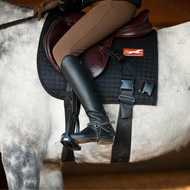
The team attached two elastic bands to a modified saddle pad using buckle clips.

Bands can be used to treat and prevent equine injuries

New research led by the RVC has found that elastic resistance bands are very effective in increasing dynamic stability of the horse in trot.

Up to now, there has been little supporting evidence on the effect of training or rehabilitation programmes in preventing or treating lameness and back problems in horses.

But this new study proves that elastic resistance bands can be used to prevent equine injuries, as well as overcome them.

In the study, researchers employed seven privately-owned horses to undergo a four-week exercise programme. They attached two elastic bands to a modified saddle pad using buckle clips. The bands were fitted at a tension 30 per cent tension.

The team then used a statistical model to assess the effect of band usage, investigate the effect of time and examine whether the horse moved in-hand or on the left of right turn on the lunge. They calculated the back movement parameters from a total of 3,215 strides at week one and at week four, with and without exercise bands.

Riders reported a ‘greater stability of movement’ when the elastic bands were used. This was backed by the study, which found that when using bands there was less roll and pitch in the lower back. There was also less left-right movement in the mid-thoracic and lumbar regions.

“The system, we tested is easy to use during the normal exercise routine of a horse, meaning it can be applied to horses of any discipline,” explained lead researcher Dr Thilo Pfau, senior lecturer in bio-engineering at the RVC. “It also takes very little time to apply to the horse, considering all it entails is attaching the bands to a modified saddle pad, and it can be used during ridden exercise.”

The team are now encouraging future studies to directly measure muscle activity to increase understanding of the underlying mechanisms involved in providing increased dynamic stability.

Image (C) RVC

Become a member or log in to add this story to your CPD history

Equine Disease Surveillance report released for Q4 2025

News Story 1
 The latest Equine Disease Surveillance report has been released, with details on equine disease from Q4 of 2025.

The report, produced by Equine Infectious Disease Surveillance, includes advice on rule changes for equine influenza vaccination.

Statistics and maps detail recent outbreaks of equine herpes virus, equine influenza, equine strangles and equine grass sickness. A series of laboratory reports provides data on virology, bacteriology, parasitology and toxicosis.

This issue also features a case study of orthoflavivus-associated neurological disease in a horse in the UK. 

Click here for more...
News Shorts
NSA webinar explores sheep tailing and castration

The National Sheep Association (NSA) is to host a free webinar on the castration and tail docking of lambs.

The webinar, 'Understanding the tailing and castration consultation: A guide for sheep farmers', will be hosted online on Monday, 2 March 2026 at 7.30pm.

It comes during a government consultation into the methods used for these procedures. Farmers are encouraged to engage before the consultation period closes on Monday, 9 March 2026.

The webinar offers clear and actionable guidance to support farmers to contribute meaningfully to the consultation and prepare for potential changes.

On the panel will be former SVS president Kate Hovers, farmer and vet Ann Van Eetvelt and SRUC professor in Animal Health and Veterinary Sciences Cathy Dwyer. Each panel member will utilise their own specialism and expertise to evaluate risks and outcomes to sheep farming.

Find out more about the webinar on the NSA website.


