
Your data on MRCVSonline
The nature of the services provided by Vision Media means that we might obtain certain information about you.
Please read our Data Protection and Privacy Policy for details.

In addition, (with your consent) some parts of our website may store a 'cookie' in your browser for the purposes of
functionality or performance monitoring.
Click here to manage your settings.
If you would like to forward this story on to a friend, simply fill in the form below and click send.

Your friend's email:
Your email:
Your name:
 
 
Send Cancel

Drumming cockatoos have signature beats
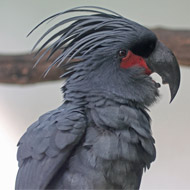
Palm cockatoo
Palm cockatoos are known for their shyness and elusiveness.

Researchers analyse courting behaviour for the first time

The animal kingdom isn’t short of musical animals; whales and birds can often be heard belting out a song. But new research of the palm cockatoo’s ability to drum has found that not only can it thrash out a tune - but it can also keep a beat.

It has long been known that palm cockatoos bang sticks on tree trunks to impress the opposite sex. But in a new study, researchers at Australian National University (ANU) secured video footage of this behaviour and were able to analyse it for the first time.

The researchers gained the footage slowly over seven years by stalking the birds though the rainforest. They observed the parrots fashion sticks from branches, grip them with their feet and bang them on trunks and tree hollows.

“The icing on the cake is that the taps are almost perfectly spaced over very long sequences, just like a human drummer would do when holding a regular beat,” said Professor Rob Heinsohn, from the ANU Fenner School of Environment and Study.

The footage also revealed that each of the 18 male palm cockatoos, known to be shy and elusive, had their own style or signature drum beat.

"Some males were consistently fast, some were slow, while others loved a little flourish at the beginning,” Professor Heinsohn continued. “Such individual styles might allow other birds to recognise who it is drumming from a long way away."

Iconic to Cape York Peninsular in North Queensland, Palm cockatoos are known for their shyness and elusiveness. The drumming is part of the series courtship ritual that involves a lot of calls and movements to attract a mate.

The research, published in Science Advances, is part of a wider study on the conservation needs of palm cockatoos on Cape York Peninsula, where they suffer from low breeding success and loss of habitat due to mining.

Image (C) Dick Daniels/ Wikimedia Commons

Become a member or log in to add this story to your CPD history

Equine Disease Surveillance report released for Q4 2025

News Story 1
 The latest Equine Disease Surveillance report has been released, with details on equine disease from Q4 of 2025.

The report, produced by Equine Infectious Disease Surveillance, includes advice on rule changes for equine influenza vaccination.

Statistics and maps detail recent outbreaks of equine herpes virus, equine influenza, equine strangles and equine grass sickness. A series of laboratory reports provides data on virology, bacteriology, parasitology and toxicosis.

This issue also features a case study of orthoflavivus-associated neurological disease in a horse in the UK. 

Click here for more...
News Shorts
NSA webinar explores sheep tailing and castration

The National Sheep Association (NSA) is to host a free webinar on the castration and tail docking of lambs.

The webinar, 'Understanding the tailing and castration consultation: A guide for sheep farmers', will be hosted online on Monday, 2 March 2026 at 7.30pm.

It comes during a government consultation into the methods used for these procedures. Farmers are encouraged to engage before the consultation period closes on Monday, 9 March 2026.

The webinar offers clear and actionable guidance to support farmers to contribute meaningfully to the consultation and prepare for potential changes.

On the panel will be former SVS president Kate Hovers, farmer and vet Ann Van Eetvelt and SRUC professor in Animal Health and Veterinary Sciences Cathy Dwyer. Each panel member will utilise their own specialism and expertise to evaluate risks and outcomes to sheep farming.

Find out more about the webinar on the NSA website.


