
Your data on MRCVSonline
The nature of the services provided by Vision Media means that we might obtain certain information about you.
Please read our Data Protection and Privacy Policy for details.

In addition, (with your consent) some parts of our website may store a 'cookie' in your browser for the purposes of
functionality or performance monitoring.
Click here to manage your settings.
If you would like to forward this story on to a friend, simply fill in the form below and click send.

Your friend's email:
Your email:
Your name:
 
 
Send Cancel

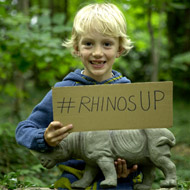
Boy hatches plan to save rare rhino from extinction
Six-year-old Frankie hopes his project will encourage others to think about what is happening to rhinos.

Six-year-old Frankie launches RhinosUp project

A six-year-old boy from Cambridge has devised a plan to save one of the world’s rarest species of rhino from extinction.

After finding out that there are just three northern white rhinos left in the world, Frankie Benstead decided to launch a fundraising project called RhinosUp.

His novel idea is to create a piece of public art in one of his local parks. The piece would be a living sculpture, made out of bee-friendly flowers, in the shape of a northern white rhino.
In Frankie’s words, he’d like “the flowers to come UP and the rhinos to come UP from the dead. That’s why I call it RhinosUp.”

Frankie has presented his proposal to Cambridge City Council and is working with them to make his dream become a reality.

In recent years, the surge in poaching for rhino horn has seen record numbers of rhino killed. The three remaining northern white rhino live at Ol Pejeta Conservancy in Kenya, where they are kept under constant watch from poachers.

Partnering with Fauna & Flora International, Frankie hopes the flowerbed will encourage people to think about what is happening to rhinos.

His goal is to raise a staggering £48,000 - equal to a single rhino horn on the black market. Frankie said this is a modest target if we are to “show that poaching and extinction has to end.”

The funds will go towards Ol Pejeta Conservancy’s work to protect rhinos. Not only is this home to the remaining northern white rhinos, but it also boasts East Africa’s largest population of black rhinos - another endangered species.

Image (C) Tom Aveling.

Become a member or log in to add this story to your CPD history

Equine Disease Surveillance report released for Q4 2025

News Story 1
 The latest Equine Disease Surveillance report has been released, with details on equine disease from Q4 of 2025.

The report, produced by Equine Infectious Disease Surveillance, includes advice on rule changes for equine influenza vaccination.

Statistics and maps detail recent outbreaks of equine herpes virus, equine influenza, equine strangles and equine grass sickness. A series of laboratory reports provides data on virology, bacteriology, parasitology and toxicosis.

This issue also features a case study of orthoflavivus-associated neurological disease in a horse in the UK. 

Click here for more...
News Shorts
NSA webinar explores sheep tailing and castration

The National Sheep Association (NSA) is to host a free webinar on the castration and tail docking of lambs.

The webinar, 'Understanding the tailing and castration consultation: A guide for sheep farmers', will be hosted online on Monday, 2 March 2026 at 7.30pm.

It comes during a government consultation into the methods used for these procedures. Farmers are encouraged to engage before the consultation period closes on Monday, 9 March 2026.

The webinar offers clear and actionable guidance to support farmers to contribute meaningfully to the consultation and prepare for potential changes.

On the panel will be former SVS president Kate Hovers, farmer and vet Ann Van Eetvelt and SRUC professor in Animal Health and Veterinary Sciences Cathy Dwyer. Each panel member will utilise their own specialism and expertise to evaluate risks and outcomes to sheep farming.

Find out more about the webinar on the NSA website.


