


Equine researchers update vets on Coronavirus
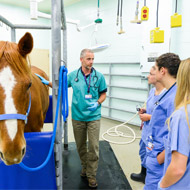
Dr. Nicola Pusterla discusses equine medicine with UC Davis veterinary students.
Vets remain baffled about the origin of equine coronavirus (ECoV), but researchers at UC Davis are hopeful to someday find the root cause.
In the last few years, vets have observed many commonalities among horses infected with the disease, which is helping them to better diagnose and treat the disease, as well as helping horse owners manage or even prevent an outbreak.
Some people think EcoV may have developed from above coronavirus and spread across species. What is understood about the spread of ECoV among horses is that respiratory shedding of the disease is unlikely. Most of the time, according to Dr Nicola Pusterla, it can transfer from horse-to-horse via exposure to contaminated faeces.
Due to a fresh wave of outbreaks bringing patients to the hospital, Dr Nicola Pusterla recently gathered all of the clinical equine vets at UC Davis to update them on the disease. His presentation covered a research project into the disease and reviewed several case studies to better prepare the clinicians for ECoV cases that may arrive at their Large Animal Clinic.
The school’s research revealed that most horses with ECoV will present as anorexic and lethargic with an elevated rectal temperature (>101.5ºF). Some of the less common signs may include diarrhoea, colic and neurologic defects, such as aimless wondering, head pressing, recumbency or seizures.
But Dr Pusterla stressed that vets should not assume that symptomatic horses have ECoV and asymptomatic horses do not. PCR testing throughout the research confirmed that 10-20 per cent of asymptomatic horses involved in outbreaks have detectable ECoV in their faces.
ECoV was first identified in foals over 20 years ago, but the disease in adult horses has only recently been recognised as a new virus. Up to now, few studies have been carried out to understand the virus and its disease.
Outbreaks around the world among adult horses confirm that ECoV is not age specific. In 2011, a group of adult racing horses in Japan contracted the disease, and groups of adult horses in facilities in more than 10 US states were infected between 2011-14.
Working with many of these facilities, UC Davis helps to contain the outbreaks by offering diagnostic support in exchange of clinical and biological information on the infected horses. The data helps researchers further their understanding of ECoV and gain valuable epidemiological information.
For horse owners, this research brings much good news. First of all, the mortality rate is low. While many horses will contact ECoV, few will die from it. In a recent study led by UC Davis, only eight per cent of horses infected with ECoV died as a result of complications.
Furthermore, the infection is, on the whole, short-lived. Researchers say that clinical signs only persist for one to four days and are cleared with general supportive care.
Dr Pusterla encourages horse owners to enforce biosecurity protocols to prevent the spread of ECoV and take extra precautions at events where large groups of horses convene.


 Defra has published guidance for the vet sector ahead of a proposed UK-EU Sanitary and Phytosanitary agreement.



