
Your data on MRCVSonline
The nature of the services provided by Vision Media means that we might obtain certain information about you.
Please read our Data Protection and Privacy Policy for details.

In addition, (with your consent) some parts of our website may store a 'cookie' in your browser for the purposes of
functionality or performance monitoring.
Click here to manage your settings.
If you would like to forward this story on to a friend, simply fill in the form below and click send.

Your friend's email:
Your email:
Your name:
 
 
Send Cancel

Asian hornet found in Devon
Asian hornets were first seen in the UK last year.
Work is underway to trace nests

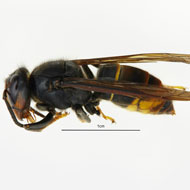
An Asian hornet has been found at an apiary in Devon, posing a potential risk to native honeybees.

This is the only confirmed sighting since the invasive species was first seen in the UK last year. A nest found in Tetbury, Gloucestershire, was promptly traced and destroyed by bee inspectors.

Asian hornets are smaller than our native hornets and pose no greater risk to humans than bees. However, they do prey on honeybees.

The hornet found in Devon is undergoing DNA testing at the National Bee Unit to establish how it came to be in the UK.

Work is underway to find and destroy any nests that may be present in north Devon, where the latest hornet was found. A local control centre will be opened this week and APHA bee inspectors will carry out surveillance and monitoring in a 1-2km radius around the initial sighting near Woolacombe.

Inspectors will track hornets and locate any nests using infrared cameras and traps. Nest disposal experts will offer support, using an approved pesticide to destroy any hornets found and remove their nests.

Nicola Spence, Defra’s deputy director for plant and bee health, commented: “Following the successful containment of the Asian hornet incursion in Gloucestershire last year, we have a well-established protocol in place to eradicate them and control any potential spread.

“We remain vigilant across the country, working closely with the National Bee Unit and their nationwide network of bee inspectors.”

Anyone who believes they have found a nest is encouraged not to approach it, but to report the sighting on the Asian Hornet App (available for free from Apple and Android app stores). Sightings can also be reported by email to alertnonnative@ceh.ac.uk with a photo, or via www.nonnativespecies.org.

Become a member or log in to add this story to your CPD history

Equine Disease Surveillance report released for Q4 2025

News Story 1
 The latest Equine Disease Surveillance report has been released, with details on equine disease from Q4 of 2025.

The report, produced by Equine Infectious Disease Surveillance, includes advice on rule changes for equine influenza vaccination.

Statistics and maps detail recent outbreaks of equine herpes virus, equine influenza, equine strangles and equine grass sickness. A series of laboratory reports provides data on virology, bacteriology, parasitology and toxicosis.

This issue also features a case study of orthoflavivus-associated neurological disease in a horse in the UK. 

Click here for more...
News Shorts
NSA webinar explores sheep tailing and castration

The National Sheep Association (NSA) is to host a free webinar on the castration and tail docking of lambs.

The webinar, 'Understanding the tailing and castration consultation: A guide for sheep farmers', will be hosted online on Monday, 2 March 2026 at 7.30pm.

It comes during a government consultation into the methods used for these procedures. Farmers are encouraged to engage before the consultation period closes on Monday, 9 March 2026.

The webinar offers clear and actionable guidance to support farmers to contribute meaningfully to the consultation and prepare for potential changes.

On the panel will be former SVS president Kate Hovers, farmer and vet Ann Van Eetvelt and SRUC professor in Animal Health and Veterinary Sciences Cathy Dwyer. Each panel member will utilise their own specialism and expertise to evaluate risks and outcomes to sheep farming.

Find out more about the webinar on the NSA website.

