
Your data on MRCVSonline
The nature of the services provided by Vision Media means that we might obtain certain information about you.
Please read our Data Protection and Privacy Policy for details.

In addition, (with your consent) some parts of our website may store a 'cookie' in your browser for the purposes of
functionality or performance monitoring.
Click here to manage your settings.
If you would like to forward this story on to a friend, simply fill in the form below and click send.

Your friend's email:
Your email:
Your name:
 
 
Send Cancel

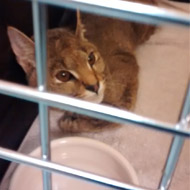
Jungle cat handed in to RSPCA hospital
Jungle cats are commonly found living in the wild in India, Pakistan and Bangladesh.

Animal thought to have been kept as an exotic pet 

The RSPCA has launched an appeal for information after a sick jungle cat was handed to one of its London veterinary hospitals.

The male cat, thought to be around two years old, was handed to veterinary staff at Putney Animal Hospital on Tuesday (14 November) by an anonymous person.
As soon as staff realised it was not a domestic cat, they contacted animal collection officer Jill Sanders who secured him inside a carrier.

“This was a really beautiful animal but you could tell straight away he was unusual,” she explained. “He was bigger than a normal cat with very distinctive ears, and he was very frightened.

“Once I secured him in the carrier I transported him to exotic animal specialists at Heathrow, as I knew they would have the expertise to officially identify him, and care for him.”

Commonly found living wild in Bangladesh, Pakistan and India, jungle cats can grow up to 110cm in length and around 130cm tall. Their long, distinctive ears have a tuft of hair at the tips and, compared to a domestic cat, their tails are relatively short.

Jungle cats are different to many cat species in that they are good swimmers and will dive into the water to catch fish. Besides rodents, they also hunt birds, amphibians, reptiles and have even been known to kill wild pigs.

The RSPCA believes the jungle cat might have been kept as an exotic pet. But as they are wild animals with very specific needs, the organisation says that it would be impossible to keep such animal in a typical household environment.

An assessment of the cat found him to be very underweight and suffering from an infection. As such, the vet decided that the kindest option would be to euthanise him to prevent further suffering. 

Image (C) RSPCA

Become a member or log in to add this story to your CPD history

Vets launch new podcast for pet owners

News Story 1
 Two independent vets have launched a podcast to help owners strengthen their bond with pets. Dr Maggie Roberts and Dr Vanessa Howie, who have worked in both veterinary practice and major charities, are keen to use their experience to enable people to give pets a better life.

The venture, called Vets Talking Pets, provides advice and information on a range of topics, including how to select a suitable pet, where to obtain them and how to get the best out of your vet. Maggie and Vanessa will also discuss sensitive subjects, including end-of-life care, raw food diets and the cost of veterinary care.

The podcast can be found on all the usual podcast sites, including Podbean, Apple, Amazon Music and YouTube. 

Click here for more...
News Shorts
VMD issues guidance on AVM-GSL packaging

The Veterinary Medicines Directorate (VMD) has shared advice on its requirements for medicines considered AVM-GSL.

The guidance explains the information that should be on the outer package, and sets out the typical maximum pack size for an AVM-GSL product. It also describes the user-friendly language, structure and phrases required on packaging and product leaflets.

AVM-GSL products do not require discussion between the purchaser and a veterinary professional. This means that clear product information is needed to support sales choices.

The information will be useful for submitting new products to the AVM-GSL category and lowering the distribution category of products from NFA-VPS to AVM-GSL.

The VMD's guidance can be accessed here.


