


Pine martens could aid red squirrel populations, study finds
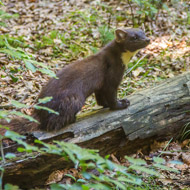
Researchers used DNA from hair samples to identify individual pine martens in three study areas:
Pine martins could aid red squirrel populations by reversing the spread of invasive grey squirrels, according to new research.
The international study, conducted by scientists from Scotland, Ireland and the US, found that pine martins feed on grey squirrels, but allow red squirrel populations to thrive.
The project was led by Dr Emma Sheehy and Professor Xavier Lambin from the University of Aberdeen’s School of Biological Sciences and published in the journal Proceedings of the Royal Society-B.
“Our study has confirmed that exposure to pine martens has a strong negative effect on grey squirrel populations, whereas the opposite effect was observed in red squirrel populations who actually benefitted from exposure to martens,” Dr Sheehy explained.
“Our evidence that, in addition to their intrinsic value, pine martens provide an ecosystem service by suppressing invasive grey squirrel populations is good news for both red squirrel conservation efforts and the timber growing industry, due to the detrimental impact of the invasive grey squirrel on both.
“The pine marten is already heavily suppressing grey squirrel populations where they are well established, and presumably this influence will spread as the pine marten’s range expands southwards through Scotland and into the North of England but this is likely to be a slow and very gradual process.”
In the study, researchers used DNA from hair samples to identify individual pine martens in three study areas: the Scottish Borders, the Highlands and Central Scotland. Spatial statistical models were then used to reconstruct individual pine marten home ranges.
“From this, we were able to quantify how much red and grey squirrels were exposed to these pine martens, and most importantly, how this is affecting their distribution,” said Dr Chris Sutherland of the University of Massachusetts Amherst.
“Studying wildlife can be difficult, particularly when investigating multi-species relationships. As such our study offers what is a very rare insight into the potential role of native predators in shifting dynamics between native and invasive prey species.”


 BVA has announced a new series of its Building Great Workplaces lunchtime webinars.



