
Your data on MRCVSonline
The nature of the services provided by Vision Media means that we might obtain certain information about you.
Please read our Data Protection and Privacy Policy for details.

In addition, (with your consent) some parts of our website may store a 'cookie' in your browser for the purposes of
functionality or performance monitoring.
Click here to manage your settings.
If you would like to forward this story on to a friend, simply fill in the form below and click send.

Your friend's email:
Your email:
Your name:
 
 
Send Cancel

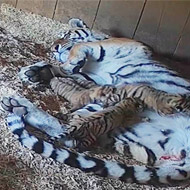
Four rare Amur tiger cubs born at Whipsnade Zoo
CCTV still of Naya in the cubbing den with her newborns.

Visitors can see the cubs exploring their new home 

Keepers at ZSL Whipsnade Zoo are celebrating the arrival of four endangered Amur tiger cubs.

Team leader Donovan Glyn said: “It’s incredible news for us to have endangered Amur tiger cubs born here at ZSL Whipsnade Zoo, but to have four of them is just amazing, especially when you consider there are only 500 left in the wild.”

The tiger cubs were born to seven-year-old Naya on Saturday (23 June) following a pregnancy of 108 days.  

Zookeepers kept a close eye on the second-time mum using a hidden camera as she delivered her first cub at 7.25pm, and were thrilled to see her give birth to a further three cubs over the next five hours.   

The family are now getting to know each other in a birthing den in the centre of the Zoo’s tiger enclosure.

“Having cameras in her den is allowing us to keep a close eye on how they’re all getting on 24/7, and it’s also letting us share in the magic of them taking their first steps,” Donovan Glyn continued.

“Naya is very attentive, cleaning the cubs regularly and letting them suckle whenever they want to. She has also stayed very calm and relaxed throughout, even when dad Botzman went in to see what was going on. He seemed to take one look at the first cub and decide to give them some space!”

Listed as Endangered by the IUCN Red List of Endangered Species, Amur tigers had been hunted to near extinction. It is thanks to the conservation efforts of organisations like ZSL that there are now an estimated 500 remaining in the wild.

Visitors to the zoo this summer will be able to see the tiger cubs exploring their new home. Zookeepers will also be revealing exclusive video footage of the cubs on the ZSL Whipsnade Zoo social media channels over the coming months. 

Image (C) ZSL London

Become a member or log in to add this story to your CPD history

Equine Disease Surveillance report released for Q4 2025

News Story 1
 The latest Equine Disease Surveillance report has been released, with details on equine disease from Q4 of 2025.

The report, produced by Equine Infectious Disease Surveillance, includes advice on rule changes for equine influenza vaccination.

Statistics and maps detail recent outbreaks of equine herpes virus, equine influenza, equine strangles and equine grass sickness. A series of laboratory reports provides data on virology, bacteriology, parasitology and toxicosis.

This issue also features a case study of orthoflavivus-associated neurological disease in a horse in the UK. 

Click here for more...
News Shorts
NSA webinar explores sheep tailing and castration

The National Sheep Association (NSA) is to host a free webinar on the castration and tail docking of lambs.

The webinar, 'Understanding the tailing and castration consultation: A guide for sheep farmers', will be hosted online on Monday, 2 March 2026 at 7.30pm.

It comes during a government consultation into the methods used for these procedures. Farmers are encouraged to engage before the consultation period closes on Monday, 9 March 2026.

The webinar offers clear and actionable guidance to support farmers to contribute meaningfully to the consultation and prepare for potential changes.

On the panel will be former SVS president Kate Hovers, farmer and vet Ann Van Eetvelt and SRUC professor in Animal Health and Veterinary Sciences Cathy Dwyer. Each panel member will utilise their own specialism and expertise to evaluate risks and outcomes to sheep farming.

Find out more about the webinar on the NSA website.


