
Your data on MRCVSonline
The nature of the services provided by Vision Media means that we might obtain certain information about you.
Please read our Data Protection and Privacy Policy for details.

In addition, (with your consent) some parts of our website may store a 'cookie' in your browser for the purposes of
functionality or performance monitoring.
Click here to manage your settings.
If you would like to forward this story on to a friend, simply fill in the form below and click send.

Your friend's email:
Your email:
Your name:
 
 
Send Cancel

Animals to be banned from Welsh circuses
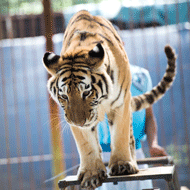
45 countries across the globe have introduced bans on animals in circuses.
Move brings UK-wide ban one step closer

The Welsh government is to introduce a ban on the use of wild animals in travelling circuses.

In a statement, a spokesperson for the government said: “The way animals are treated is an important reflection of society and over the next 12 months, a bill will be introduced to ban the use of wild animals in travelling circuses on welfare grounds”.

Jan Creamer of Animal Defenders International (ADI), which has documented suffering and use in UK circuses for many years, welcomed the move.

“We congratulate the Welsh Government for taking a stand to stop circus suffering in Wales and bringing a UK-wide ban one step closer,” she said. “Knowing that only a ban can protect them, we are delighted an end to the use of wild animals in circuses in Wales is finally within sight.”

The Bill has taken a long time to come to fruition, given that the Welsh government first committed to a ban on wild animals in circuses in 2013. In February this year, the UK government pledged to introduce a UK-wide ban by January 2020.

To date, 45 countries across the globe have introduced bans on animals in circuses, including Scotland and Ireland. Currently, there are only two circuses in England that carry wild animals and are licensed to tour in Wales - Circus Mondao and Peter Jolly’s Circus.

A third circus with big cats, owned by Thomas Chipperfield, also performed in Wales when it was unable to obtain a license in England. Since then it has remained off the road, but ADI has revealed the miserable lives suffered by its cats, which live in restricted cages and have limited outside access.

ADI also found evidence of overcrowding, fighting between animals and a worker tormenting a camel. 

Become a member or log in to add this story to your CPD history

Vets launch new podcast for pet owners

News Story 1
 Two independent vets have launched a podcast to help owners strengthen their bond with pets. Dr Maggie Roberts and Dr Vanessa Howie, who have worked in both veterinary practice and major charities, are keen to use their experience to enable people to give pets a better life.

The venture, called Vets Talking Pets, provides advice and information on a range of topics, including how to select a suitable pet, where to obtain them and how to get the best out of your vet. Maggie and Vanessa will also discuss sensitive subjects, including end-of-life care, raw food diets and the cost of veterinary care.

The podcast can be found on all the usual podcast sites, including Podbean, Apple, Amazon Music and YouTube. 

Click here for more...
News Shorts
VMD issues guidance on AVM-GSL packaging

The Veterinary Medicines Directorate (VMD) has shared advice on its requirements for medicines considered AVM-GSL.

The guidance explains the information that should be on the outer package, and sets out the typical maximum pack size for an AVM-GSL product. It also describes the user-friendly language, structure and phrases required on packaging and product leaflets.

AVM-GSL products do not require discussion between the purchaser and a veterinary professional. This means that clear product information is needed to support sales choices.

The information will be useful for submitting new products to the AVM-GSL category and lowering the distribution category of products from NFA-VPS to AVM-GSL.

The VMD's guidance can be accessed here.


